What Is Vibe Marketing?

Translated from the original Chinese article. Some illustrations are from the original and may contain Chinese text.
Anyone working in marketing should pay attention to AI Native Marketing, or what I call Vibe Marketing.
Earlier this year I shared how I built a content team with AI. I packaged activities that had previously been scattered—choosing topics, finding material, writing—as Skills in IDEs such as TRAE and Cursor, and had a coding Agent execute them.
That led me to ask: if I use Vibe Coding to produce content, is that a kind of Vibe Marketing? Vibe Marketing became popular overseas in 2025 after Vibe Coding took off there, but I did not understand it deeply enough at the time to discuss it publicly. Now that I better understand Vibe Coding and Agents, and more marketers are using Agents, I think it is time to talk about it.
Vibe Marketing originally referred to atmosphere
First, where does the concept come from?
Its roots lie in atmospheric marketing in retail and service spaces, an idea introduced by Kotler. Brands do not close sales through products and prices alone: lighting, music, scent, displays, movement through a store and service can all affect whether people stay, trust or buy. Later, atmosphere extended beyond physical stores to the rhythm of short online videos, website design, the tone of an email and even a brand's replies to comments.
So Vibe Marketing existed before AI brought us Vibe Coding. In that earlier sense, it meant deliberately defining, designing and continually calibrating the feeling a brand leaves with people at every point of contact.
An image filter, video script, visual identity or physical display is only one outward projection of a vibe. A complete vibe grows from the interaction of a brand's vision, mission and values with the world. Its core comes from the founder's temperament and experience. I may discuss this separately in the future.
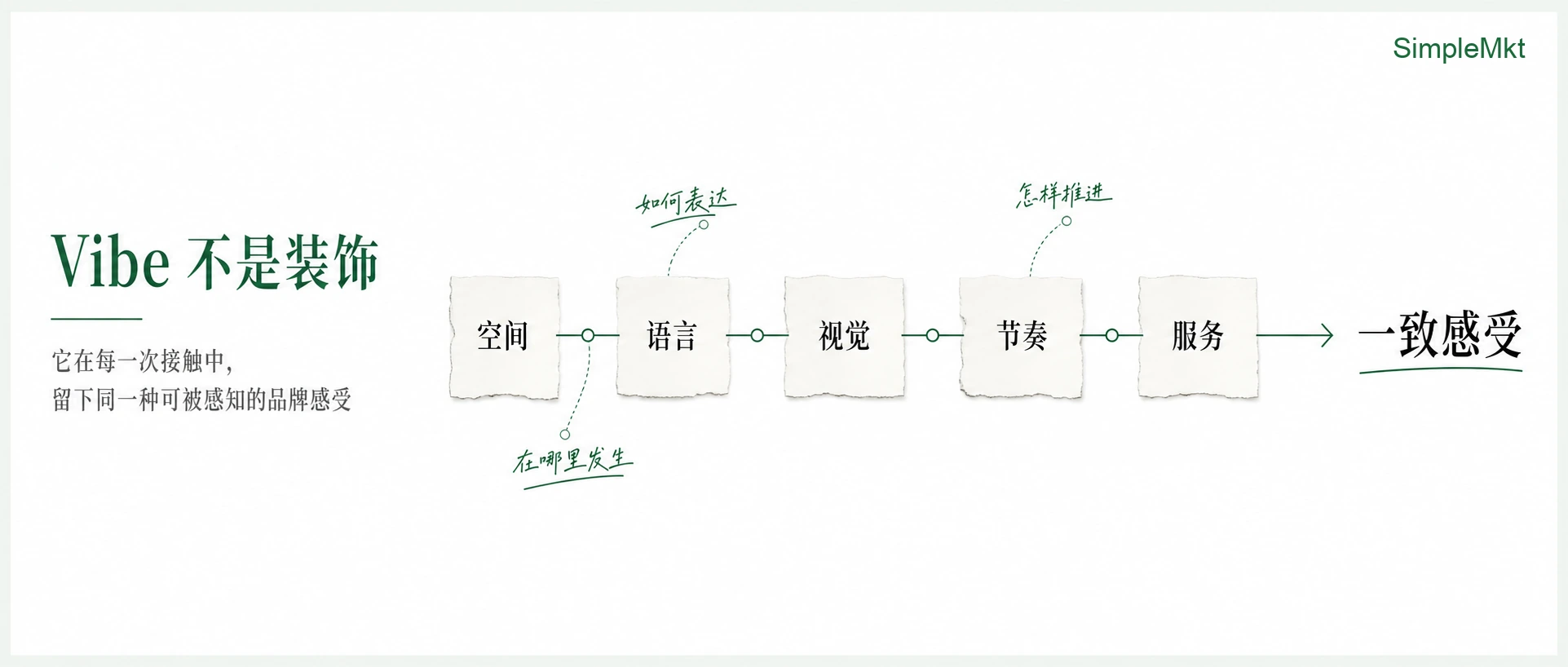
What I want to discuss today is this: in the past people mainly sensed and managed a brand's vibe themselves. In the AI era, can AI understand and execute it?
Vibe Coding lets brand judgment be put into action
My answer is yes.
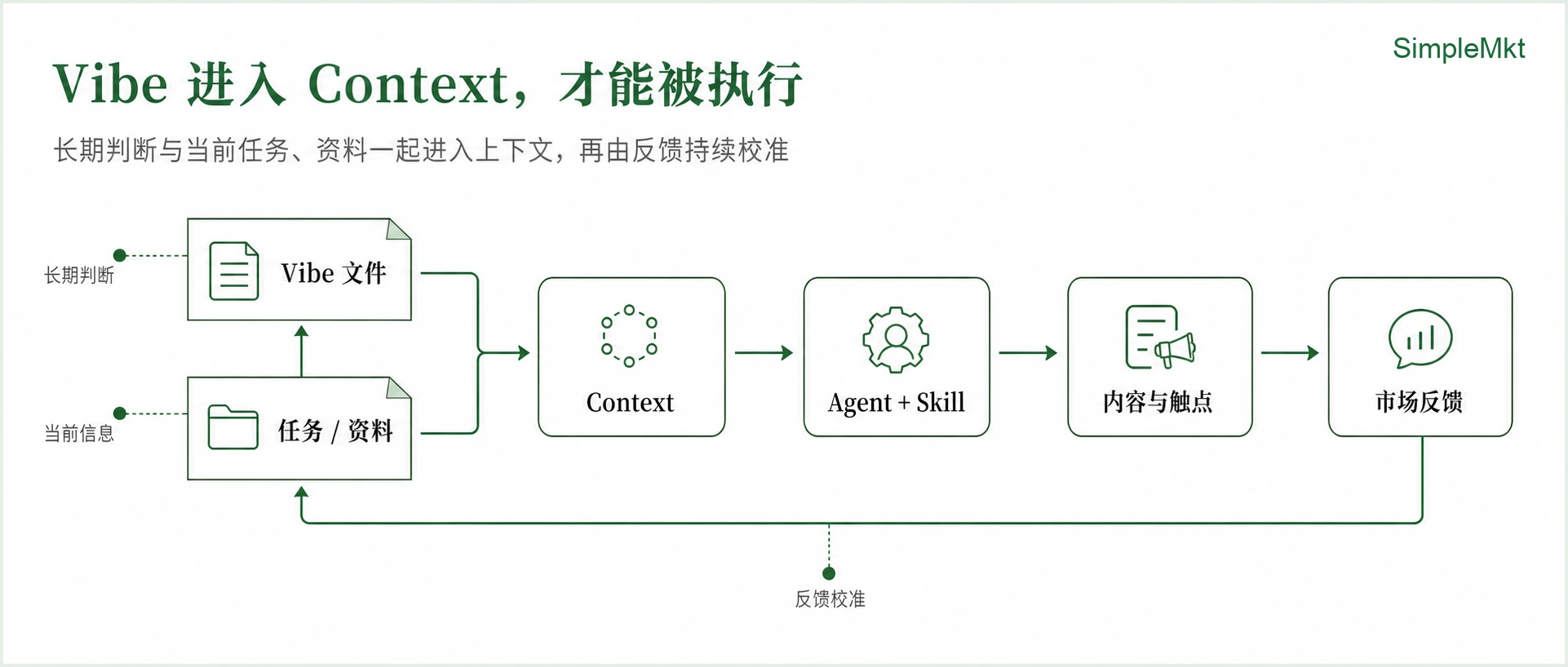
I do not mean asking AI to invent more atmospheric content from nothing. I mean turning the language of an atmosphere, once understood mainly through human feeling, into context an Agent can understand, execute and repeatedly calibrate. If you are unfamiliar with Agents or context, I recommend my other video, “AI's Core Concepts in Plain Language,” before returning to this topic.
Context is all the information a model can currently read while generating an answer or carrying out a task. It usually includes system instructions, the task, conversation history, files read, retrieved materials and tool results.
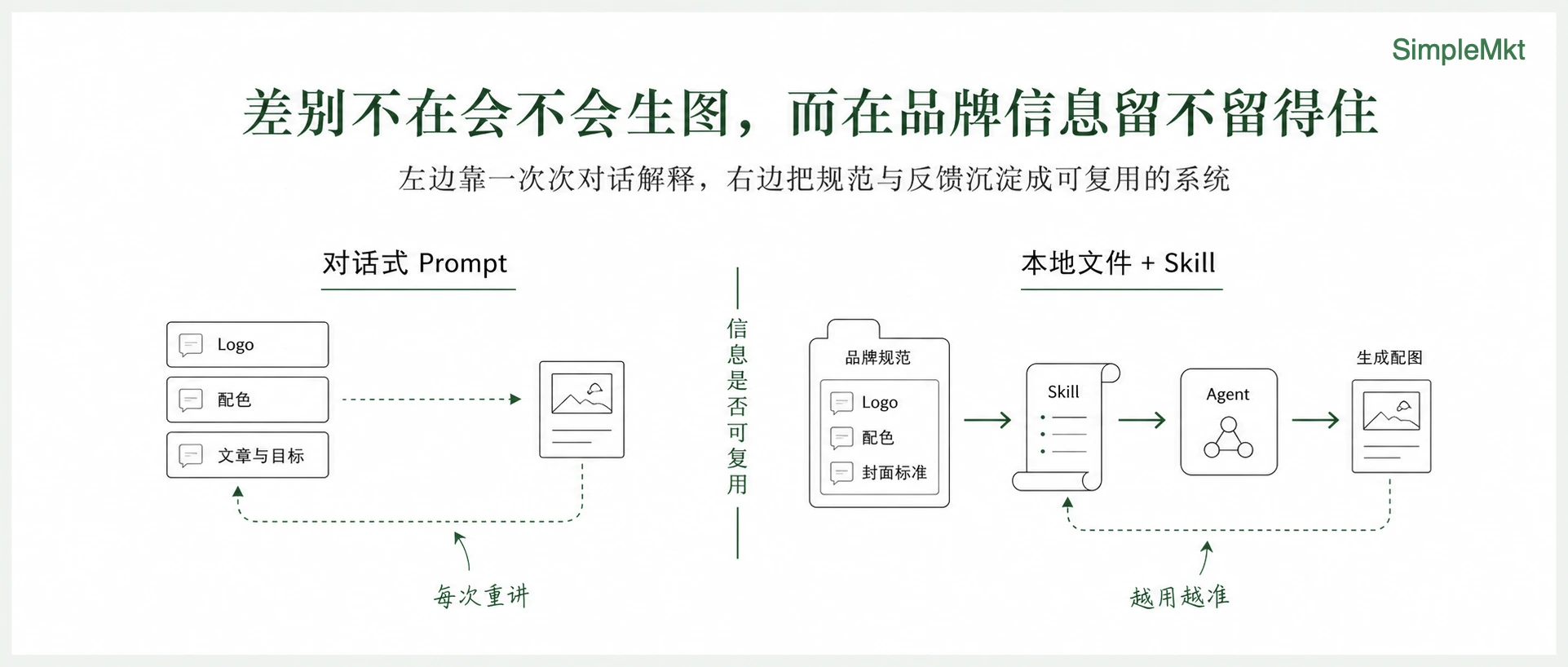
Take a basic AI marketing task: generate a brand-appropriate cover for a promotional article.
In a chat tool with image generation, such as ChatGPT, I can use successive prompts to explain the logo, colors, cover design standards, audience and article. I might ask for a proposal first, generate an image and revise if needed. The task can be completed, but each new session may require re-explaining the brand and pasting the article again. Many details survive only in chat history.
With an Agent such as Codex that can read and modify local files and generate images, I can first save the logo, colors and cover standards in a local file, then package the image-generation SOP as a Skill. Its first step can be to read the visual standards, then read the selected article and propose an illustration based on the audience and marketing objective. Once the proposal is satisfactory, it calls an image-generation tool.
I can judge the result, tell the Agent where it missed the mark and ask it to revise. I can also specify output location and naming. Most importantly, feedback can improve the saved standards and execution process: they remain local files the Agent can read and modify. Once the results meet my requirements, next time I can simply request artwork for an article, and the Agent can call the Skill without hearing every detail again.
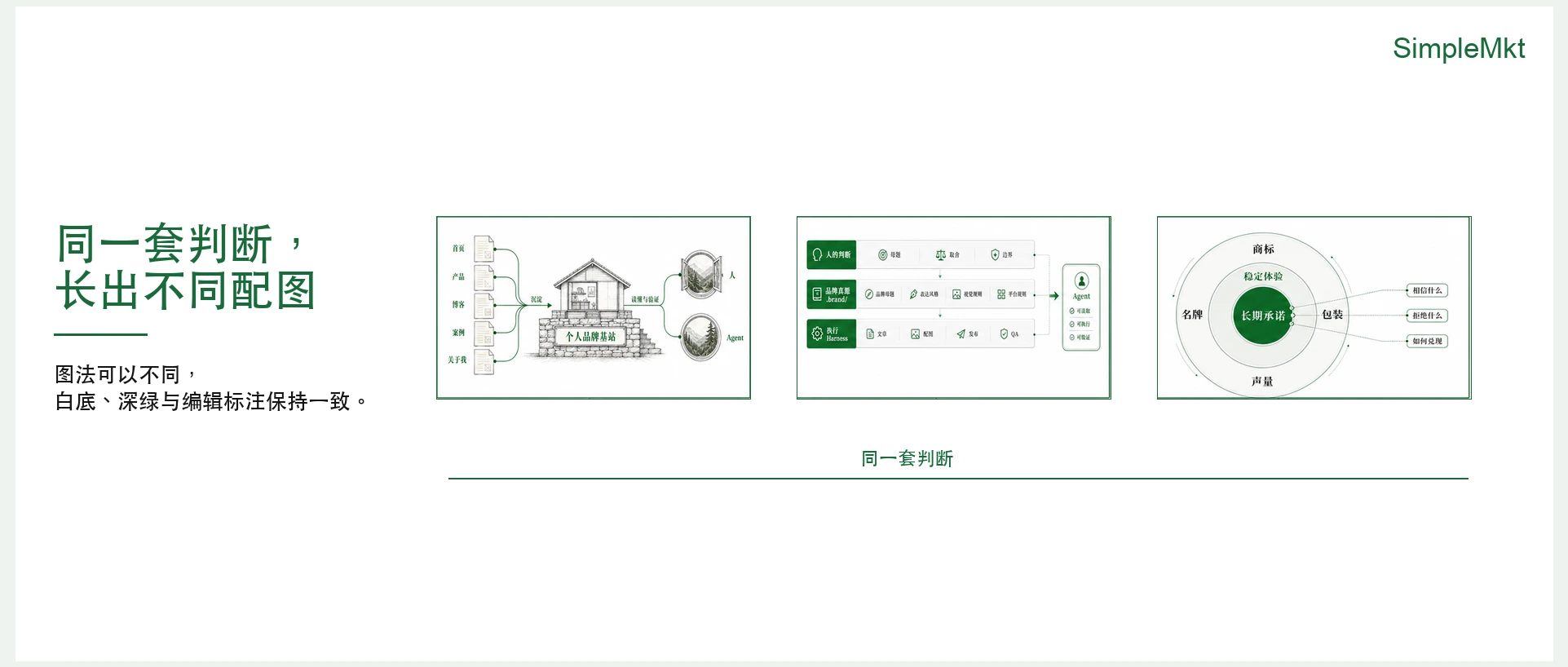
I have used the second method for many article images. The following three examples come from published articles. They address different questions but share the same visual language: white backgrounds, deep green and an editorial feel.
Write a brand's vibe into files an Agent can read
As I used this approach to write, make images, refine my personal website and build a content workbench, I noticed that a brand appears in different media—articles, images, websites—but can apply the same stable stylistic judgment behind them.
A person with a stable core can have a recognizable temperament in writing, speaking and clothing. A brand's vibe is similar: it is not the style of one article or page, but a temperament that carries across situations and media. The brand's task is to describe it consistently as context an Agent can understand.
At first I analyzed only the visual dimension, such as colors and type. As I used Agents more—for instance, to write—I could also break down an auditory vibe. When using Agents for websites and considering animation, I found a tactile vibe as well.
I created a local vibe/ folder and divided it into five sensory areas: sight, hearing, touch, smell and taste. The files describe dimensions of my stylistic judgment, which an Agent can read and use to create work that fits it.
It looks roughly like this:
vibe/
├── README.md              # Purpose, reading instructions and boundaries
├── VIBE.md                # Core judgments that must hold across contexts
├── sight/                 # How it looks: color, type, space and imagery
├── hearing/               # How it sounds: sound, tone and wording
├── touch/                 # How it feels to use: boundaries, weight and feedback
├── smell/                 # Environment: airiness, cleanliness and emotional intensity
├── taste/                 # Aftertaste: clarity, sharpness or fleeting excitement
└── dba/                   # Identity assets: stable brand anchors such as the logo
At the top is an overall Vibe file that states judgments that should not change across contexts: restraint, avoiding grand words and decoration to manufacture excitement; clarity, explaining the judgment first; honesty, not presenting wishes as facts; and other core principles.
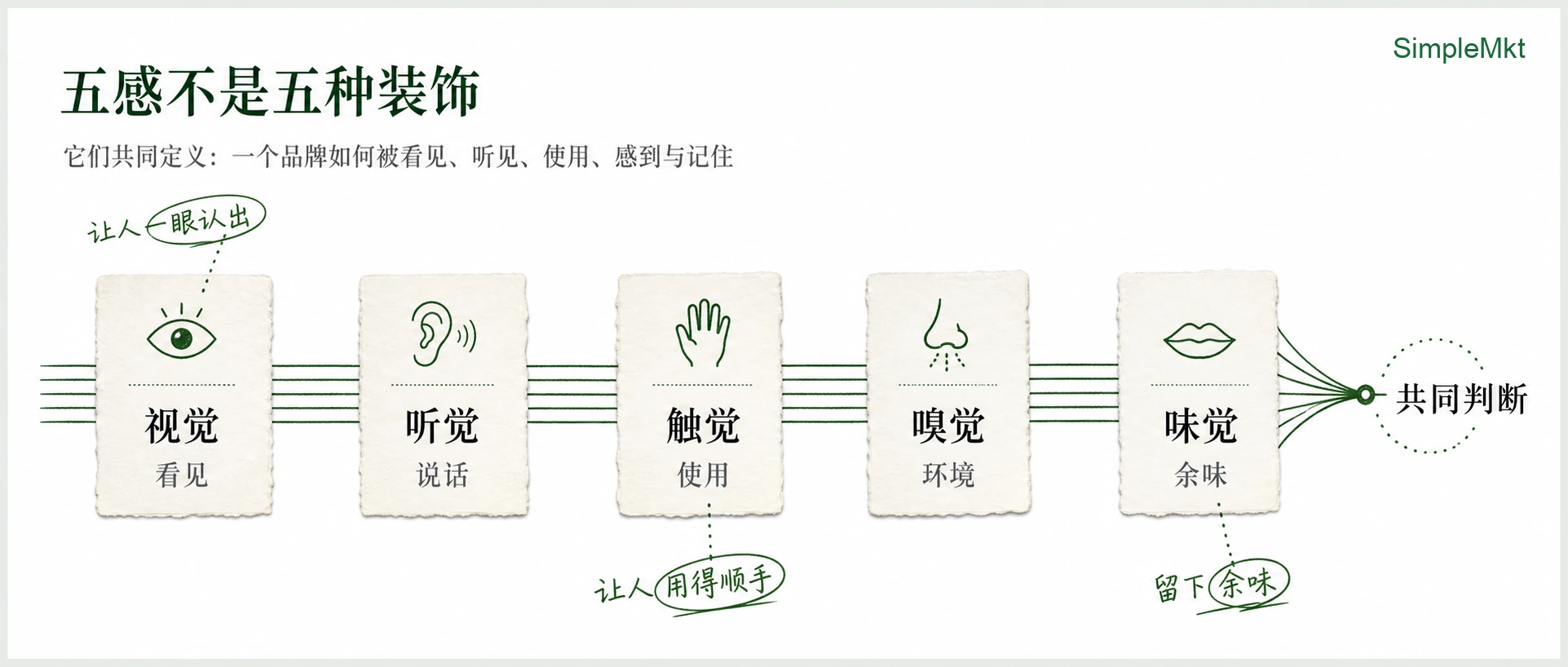
Together these five areas give an Agent a shared starting point for judging any format: what is right or wrong, what can or cannot be done, and ultimately what feels like me.
This also illustrates AI-native architectural thinking: a person supplies intention and judgment; an Agent reads and follows that intention.
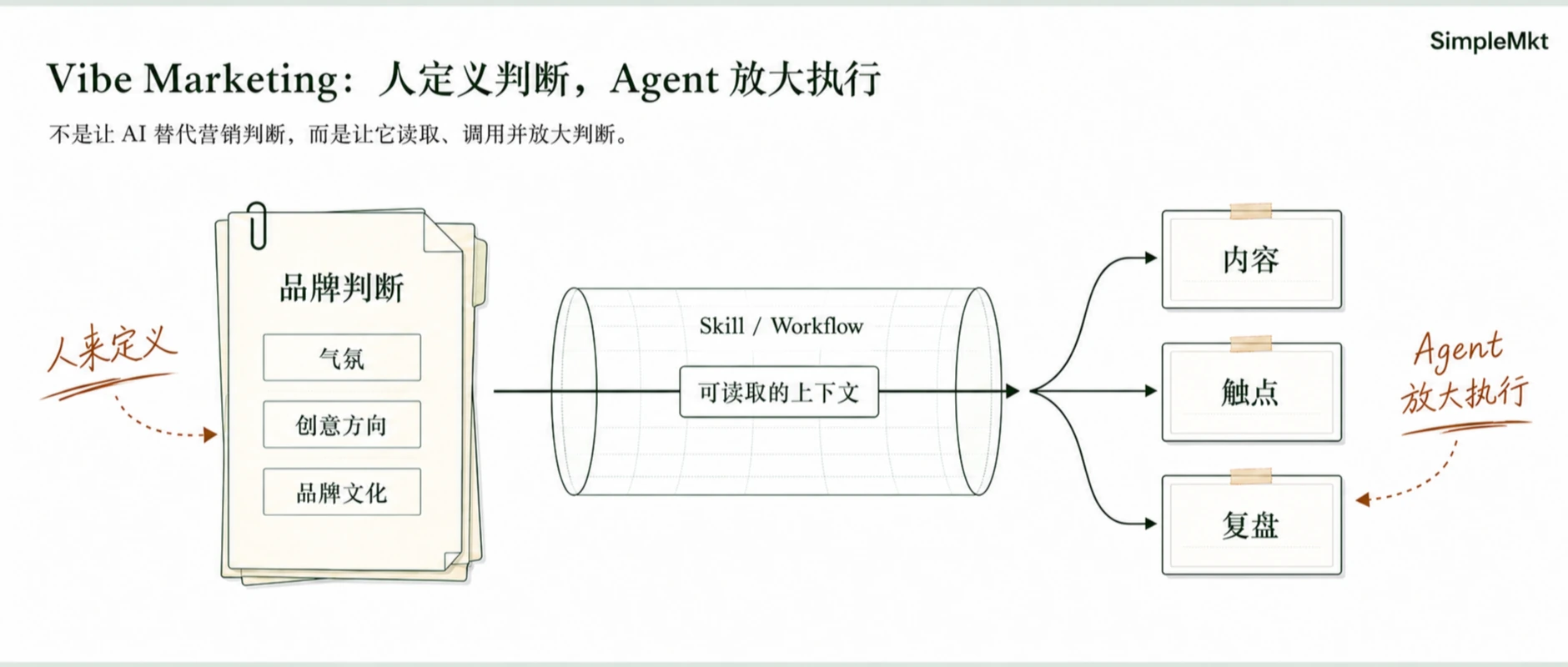
At this point the working method of Vibe Marketing should become clearer. It is a new marketing approach in which marketers concentrate on retaining judgment assets such as overall atmosphere and creative direction; use Skills, Workflows and other basic Agent techniques to build a pipeline for a category of work; and provide key information and the desired outcome so an Agent can automatically read the relevant context and generate the needed content.
It resembles an engineer writing code for a specific function, except that here the marketer implements it through AI.
More broadly, Vibe Marketing combines foundational marketing capabilities—realizing creative inspiration, embedding brand culture and analyzing data—with AI's ability to execute quickly. In short, it can let smaller marketing teams do more valuable work efficiently.
The future distinction between brands is not simply whether they use AI
My view is straightforward: AI Native Marketing is Vibe Marketing.
I believe future brands will ultimately fall into two categories: AI Native Brands and traditional brands.
The dividing line is not whether they use AI. It is whether a brand's core judgments remain only in a few people's heads or have become a source of truth and pipeline in a computer system that Agents can read, execute and calibrate.
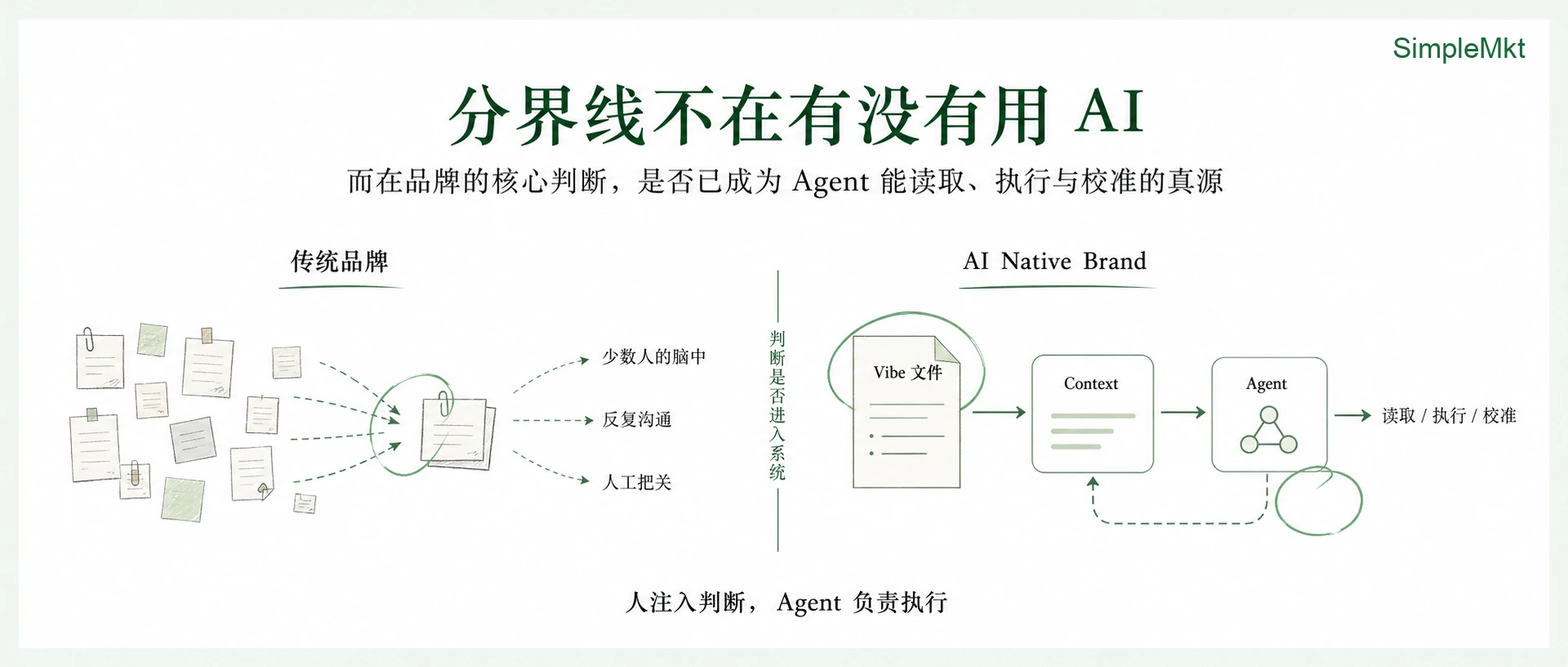
A traditional brand's vibe lives mainly in the minds of its founder, brand owner and a few core members. The more content, channels and collaborators there are, the more repeated communication and human review it takes to prevent drift.
An AI Native Brand writes the process into its content, brand and product systems. When work begins, relevant files and materials join the current task as context, forming a pipeline the Agent reads and executes.
The starting point of brand value is still human and comes principally from the founder. But the people communicating, executing and even consuming that value are no longer the only participants: an Agent has joined them.