I Built a Content Team in an AI IDE in 20 Minutes
Translated from the original Chinese article.
Why this topic?
Today I wanted to make a video about my exploration of using Vibe Coding for marketing. But sitting in front of the computer, I had a head full of ideas and no idea how to organize them into a sentence.
- If I made it very professional, I worried it would be too dry for anyone to watch.
- If I described the process, I worried it would be long, fragmented and unfocused.
- If I aimed for a viral hit, I disliked gimmicky copy.
When I actually try to create content, my biggest pain is not a lack of ideas. It is having too many and not knowing how to turn them into something comfortable to read and share that also meets my own needs.
I believe many creators have experienced this.
What is Vibe Coding?
As I wrestled with this, a question occurred to me:
If I am using Vibe Coding for marketing, could I use it to solve my own content-production problem?
So what is Vibe Coding?
Simply put, it means collaborating deeply with AI and using conversation to build code from zero to one. It is not a one-off “write me a script” request, but genuine, ongoing collaboration: you explain your ideas, uncertainties and style preferences, while AI asks questions, organizes and improves them.
I think the best place for it is an AI-native IDE. You can think of an IDE as software programmers use to manage projects: a folder contains the context of the whole project. An AI-native IDE embeds AI so you can talk with it and ask it to inspect files, organize information, write code or draft articles.
The IDE I currently use is Trae from ByteDance, with the Kimi K2.5 model.
🌰 An example: imagine brainstorming with an experienced creative producer. You don't just hand over a topic and expect a finished product; you talk, exchange ideas and iterate until both of you are satisfied. Vibe Coding brings that feeling of collaboration to AI.
Twenty minutes of deep collaboration
I started talking with AI. I clicked the microphone and explained: I wanted to become a leading creator in AI-native marketing and share my exploration of using an AI IDE for marketing projects, but I didn't know how to organize the words.
AI asked follow-up questions: Who is your audience? What problems concern them most? What do you want the video to achieve?
I described my style: logically rigorous and technically deep, but using analogies to lower the barrier to understanding, without clickbait.
AI kept organizing: so your core point is… your narrative could be structured like this… is this analogy appropriate?
Twenty minutes later, we had a complete spoken-video script.
An unexpected result: a content team as well
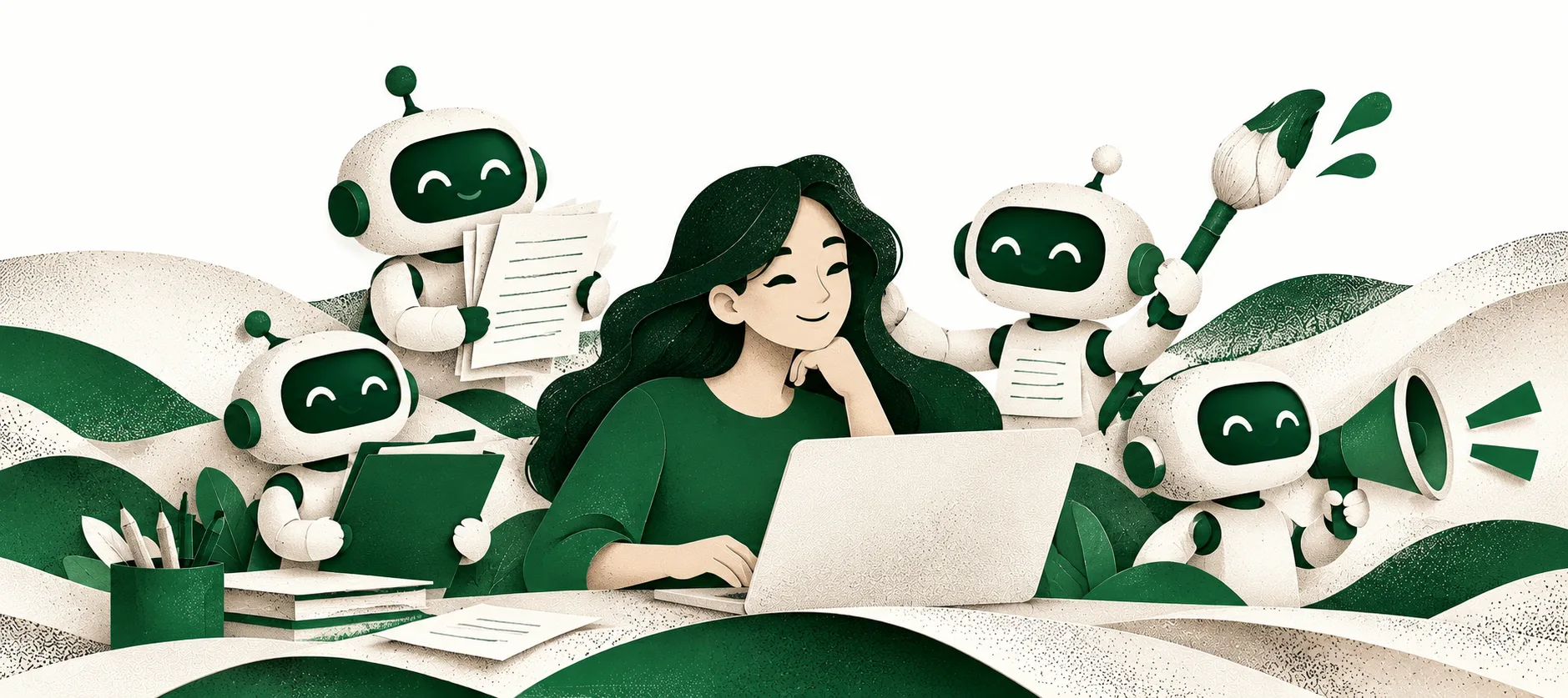
That was not the most surprising part. Along the way, I also built a four-Agent team.
I liked the process and wondered whether I could summarize the conversation so Agents or Skills could help me produce content faster. I asked AI to summarize the whole discussion and extract a team structure:
| Role | Responsibility | When it is called |
|---|---|---|
| Content producer | Plans topics and writes scripts | When my idea is vague, it asks questions to clarify it |
| Materials manager | Manages my earlier content | When I need material, a duplication check or a reference to a past article |
| Style adviser | Makes every sentence sound like me | When reviewing a new piece for stylistic consistency |
| Traffic optimizer | Handles titles, hooks and platform adaptation | When suggesting ways to reach people while preserving quality |
Each Agent has clear responsibilities, a detailed prompt and defined triggers. I am the only “human commander.”
What does this mean?
In the future, whenever I have an idea I can give it to the content producer, which can coordinate the other Agents and quickly produce content in my style.
Imagine: an idea arrives while brushing my teeth → I record it by voice on my phone → send it to AI in the IDE and @ the content producer → the producer asks several key questions → the materials manager finds relevant earlier work → the style adviser checks the tone → the traffic optimizer suggests titles → a complete script arrives shortly afterwards.
This is not science fiction. It is the reality I am building.
Honestly, many questions remain
This architecture is new and certainly has problems:
- Is coordination between Agents smooth enough? It still needs human coordination. Can Agents call one another automatically in the future?
- Can the style adviser really capture my voice? AI needs many examples and feedback to learn my style; this requires continued iteration.
- Are the traffic optimizer's titles too much like clickbait accounts? I dislike clickbait, and finding a balance between reach and quality still takes work.
So I will also try producing content with one Agent and multiple Skills. I think this may suit my early stage better.
At least I have seen a possibility: future creators may not need to maintain a content team; they may instead maintain a group of AI Agents that understand them.
From Vibe Coding to Content Coding
I have been exploring Vibe Marketing: using AI IDEs to serve the whole marketing process. Today, a small problem helped me discover a way to use an AI IDE for content production.
The underlying logic is the same: move creative work from purely manual work to human–AI collaboration, and from one-off delivery to continuous iteration.
- In marketing projects, AI helps me analyze data, develop strategy and produce reports.
- In content production, AI helps me plan topics, write scripts and manage style.
I remain focused on the creative work itself and quality control.
Advice for creators who want to try it
1. Start with a real problem. Don't use AI for its own sake. Find the most painful part of your process and use AI to address it.
2. Collaborate deeply rather than making a one-off request. Talk to AI as you would brainstorm with a colleague: have several rounds of discussion and keep clarifying instead of expecting a perfect result from one sentence.
3. Make one scenario work before expanding. Don't build an entire Agent team on day one. Start with one content type, such as a spoken-video script, and expand gradually.
4. Maintain a consistent style. AI can easily produce “correct nonsense.” Keep giving feedback and adjusting until it understands your style DNA.
5. Put quality first and traffic second. AI can optimize titles and hooks, but the core value still comes from your own thinking and insight.
If you are a creator, would you try this? Tell me in the comments, or suggest ways this architecture could be improved. Let's explore together.
Author: Alchemist Zhou Lengqing
Follow AI-native marketing and explore the possibilities of human–AI collaboration.