
China Has No Concept of Brand

Translated from the original Chinese article. Some illustrations are from the original and may contain Chinese text.
For a long time I have felt that China does not really have the Western concept of brand. I do not mean there are no trademarks or famous brands, but that the business climate often lacks the practice of managing a brand as a long-term promise.
Two sources shaped this judgment.
The first comes from my encounters with Western philosophy and other disciplines. At university I studied mathematics, economics and finance and encountered computer science and philosophy. I saw a common underlying architecture: a system starts from a foundational proposition that is not itself proved—an unconditional belief—and develops principles and extensions from it.
- Philosophy: the starting point may be a first principle such as “I think, therefore I am.” It does not establish the material source of consciousness; it sets an unconditional coordinate from which philosophers reason outward and construct boundaries between subject and object and an edifice of metaphysics.
- Mathematics: the starting point is a set of self-evident axioms or postulates. A mathematical system does not debate its starting point for every derivation; it accepts constraints and derives theorems, models and proofs.
- Economics: the starting point may be the rational-person assumption. It does not say people are always rational; it models them as pursuing their own utility under constraints, and derives supply and demand, games and financial models.
- Computer science: the starting point is axiomatic binary logic. Code does not question why 0 is 0 or 1 is 1; it follows the constraint. Boolean algebra is layered and extended to construct the universe of computer code.
From this perspective, I see Western brand building as sharing the same underlying logic: a brand first proposes its foundational belief and constructs a commercial system around it; everything serves that proposition.
Apple is my clearest example. Its proposition is not “make better computers” but “Think Different”: belief in rebellion, simplicity and the intersection of technology and the humanities. From iPhone and Mac to the minimal Apple Store, the resistance of its packaging and the feel of its launches, each expression develops and demonstrates that proposition. Nike, SpaceX and other strongly branded businesses do the same around different beliefs in different industries.
This system of saying and doing, and paying the cost to fulfill a promise, creates a demanding form of brand meaning. A buyer gets a product's use value and a whole system of commitments behind it; spending money is also a vote for the brand's values.
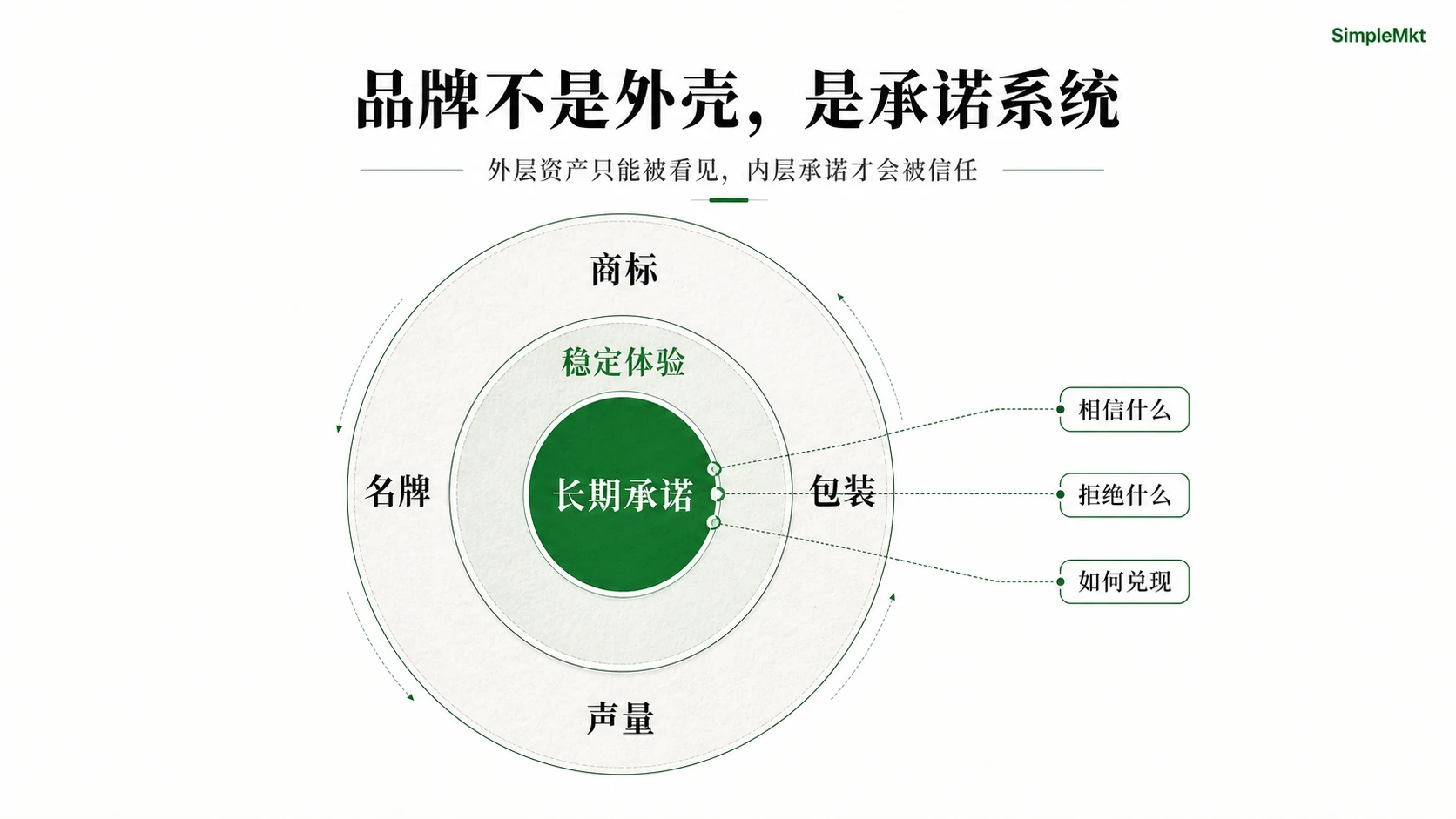
Illustration: trademarks, packaging, fame and reach are outer assets; trust comes from stable commitments—what you believe, refuse and fulfill over time.
The second source is my own work after graduation at leading domestic agencies in different fields. I have worked in data analysis, marketing strategy and advertising operations for international and Chinese brands. In my experience, the people inside them often understood brands differently:
- International brands tended to treat a brand as a promise system, use many means to deliver it and charge a premium. They paid more attention to tone and consumer experience, experimented more and emphasized logic and data in decisions, even at additional cost.
- Domestic brands tended to use brand as a marketing tool, make themselves appear more premium and charge a premium. They paid closer attention to business results and cost, pursued efficiency and traffic, added features and gave more weight to supplier-side familiarity and relationships in decisions.
This is my personal experience. Both ultimately seek a premium, but the paths feel worlds apart.
Applying that Western standard to China's market makes the disjunction sharper for me: many so-called brands arose during decades of commercial growth, but often seem to fall short of a “real brand” in this sense; some feel changeable, awkward or even a little deceptive. What might have caused this?
Three misaligned causes: why were long-term promise brands hard to grow?
I do not think the issue is entrepreneurs' ability. I see cultural, economic and technological paths.
1. Culture: individualism versus relational identity
I see Western culture as individual-centered: “who I am” is defined internally and the brand is its organized commercial projection. It seeks consistency across contexts: regardless of who you are or where and when you buy, the promise and price remain stable. Integrated marketing similarly seeks consistent value expression and delivery across a complex, fragmented media environment.
I see traditional Chinese culture as relational: “who I am” depends on whom I am with. To parents I am a child, to a boss a subordinate, to friends a brother. Identity is described through surrounding relationships. As someone born after 2000, I notice that people born in the 1980s or earlier often introduce themselves through their profession, industry, employer or a relative; relationships make identity legible.
In this culture, trust is not uniformly conveyed through a statement of identity but more through familiarity in a particular relationship. Declaring terms too firmly or making standards absolute can seem inflexible or inconsiderate. Brands therefore often adapt by time and place and convey relational value, such as status: a phone that shows someone is a successful boss, or a car that signals a family-oriented husband or stable professional.
Stating boundaries can also feel as if it harms a relationship: “We are close—why say that to me?” The Chinese expression “say the ugly thing first” suggests that declaring boundaries in advance is not the default. I am not judging which culture is better; I think their different definitions of self produce different commercial outcomes.
2. Policy and economics: long accumulation versus uncertainty
A true brand carries a high time cost: a company must resist immediate temptations for decades to maintain a reliable promise. In China's fast-growing economy of recent decades, policy changes and rapidly shifting market opportunities were major variables.
Policy can cause an industry to disappear or grow from nothing into a trillion-scale market. Brand accumulation cannot keep pace with policy change. A rational strategy can therefore be flexibility—turn quickly toward policy and market opportunities—rather than a fixed long-term commitment. A normal business operating under high uncertainty may reasonably do what makes money and move to whichever channel has an advantage. I see this as contributing to a “white-label” mindset embracing uncertainty.
My younger self might criticize firms, but they are not stupid: the likely return on brand building can be far lower than investment in channels, traffic, relationships and policy sensitivity.
3. Technology: platform dependence versus brand sovereignty
China did have a PC internet era, but in my view moved quickly into mobile-platform dominance without developing as long a tradition as Europe and the US of brand-owned homepages, independent sites and digital assets. I think this technological discontinuity is underestimated.
Western businesses experienced a full PC era and became accustomed to maintaining their own sites and accumulating digital assets. A site is more than a sales channel: it is a place to assert brand sovereignty, build audience assets and deliver a complete promise. International brand sites often have developed systems, supported by a wide ecosystem of infrastructure. International brands entering China also tend to value their own digital channels, apps, mini programs, membership and CRM: they recognize that if all customer relationships live on a platform, brand sovereignty weakens.
Because China moved quickly into mobile internet, many companies have depended from birth on super-platforms such as Taobao, JD, Douyin and WeChat. Many still equate buying traffic, generating GMV, publishing content and advertising on platforms with building a brand. They do not own the customer relationship; most contact occurs on platforms whose rules everyone must follow. Brands become sophisticated tenants.
Together these factors made “brand = long-term promise system” hard to justify as the optimal business choice:
- Culture made “brand = boundaries” a difficult fit.
- Policy and economics made “brand = a long-term promise moat” less economical.
- Technology limited the chance for “brand = an owned asset base” to develop.
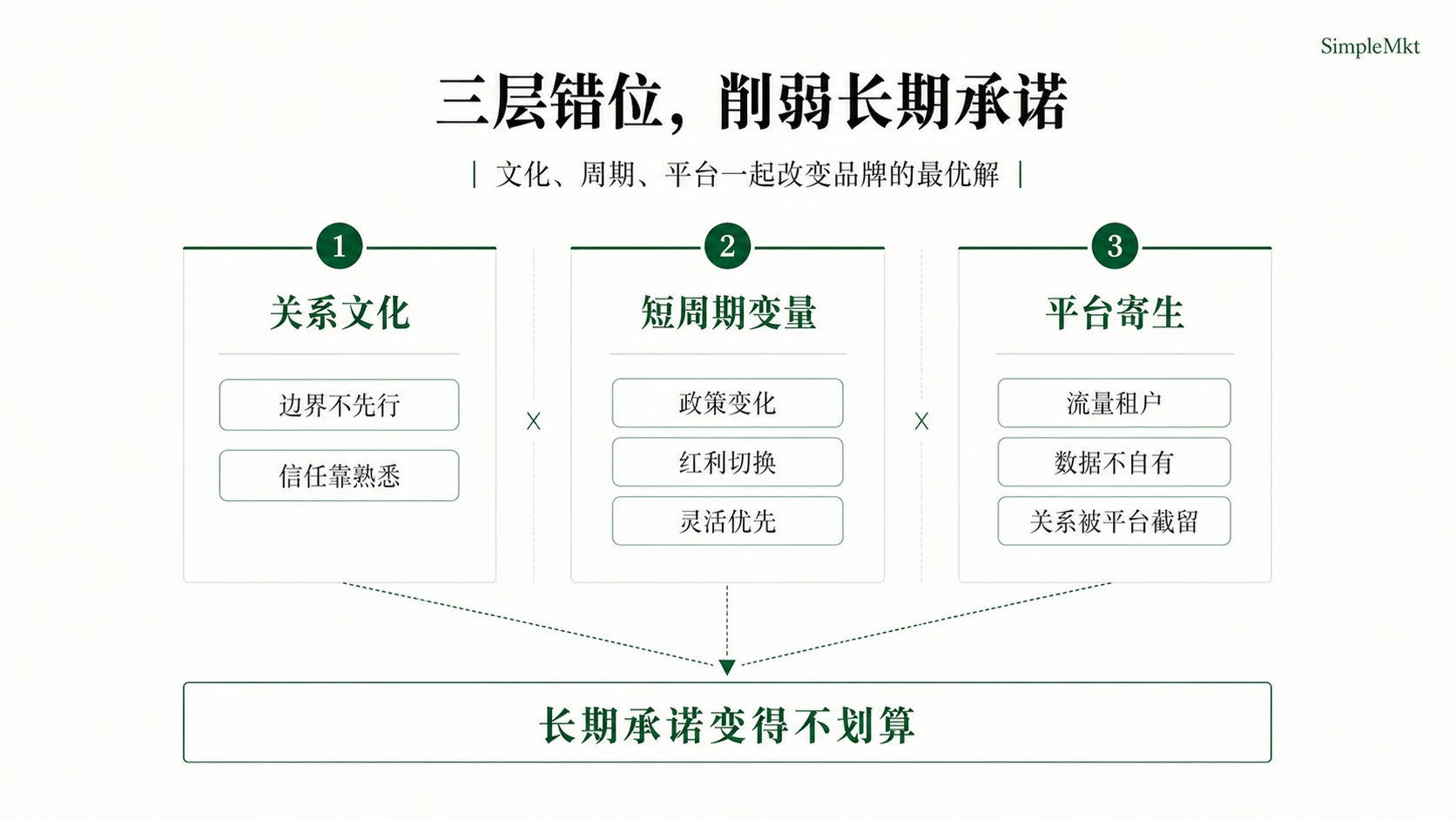
Illustration: the three forces together made a long-term promise system a difficult choice in the past.
In China, brand builders often first consider policy alignment, then whether a platform benefits, then whether the brand supplies a valuable social relationship, and only finally who the brand is and for whom it creates value.
During rapid growth, many brands could still earn a share. With AI, slowing consumer-demand growth and greater price sensitivity, brand management built on ambiguity and changeability may run into a wall of trust.
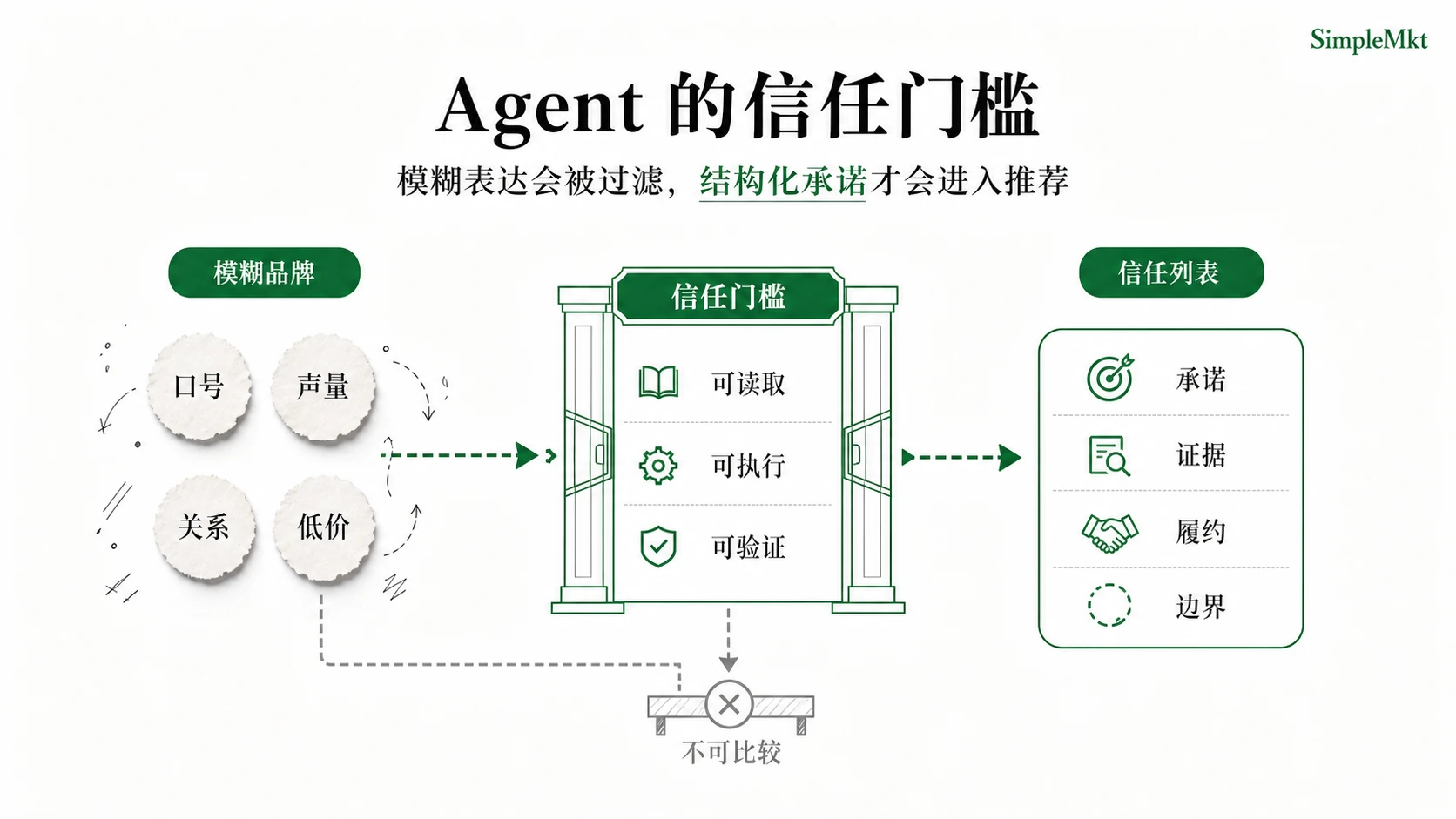
Illustration: relationships, reach and low prices could compensate for ambiguity; in an Agent decision chain, a brand may first face a readability, executability and verification threshold.
AI's productivity revolution may reset brand management
Marx's labor theory of value says productive forces determine production relations. The steam engine was not just a faster horse: it gave rise to factories and urbanization, rewriting social organization. Electricity was not just a brighter candle, nor the internet just a faster letter. Each productivity revolution made old relations obsolete, not merely faster.
I see AI as a productivity revolution of the same order, including LLMs, Agents and emerging Agent operating systems. Its biggest effect on brands is not faster copy, images or ad placement—those are efficiency gains—but changing how brand promises exist.
First, AI is a productive force: content, product and service generation and iteration become cheaper; the ability to speak, create content or produce images becomes less scarce.
Second, AI becomes a production factor. Brand knowledge scattered across people's experience, presentations, websites, support scripts, product documents and advertising becomes organized into callable assets.
More importantly, AI can change production relations. Kotler's human-to-human brand relationship involved people defining the brand, producing and placing content and serving customers, while people saw ads, searched reviews, watched livestreams, compared features and decided. In the future two new actors may stand between brand and customer:
- A brand Agent organizes promises, products, service, pricing, evidence and fulfillment history into a callable system.
- A consumer Agent searches, compares, filters, negotiates, orders and perhaps continues to monitor after-sales service for the user.
The central change is a move from expressing value to people to organizing value as a system Agents can read, execute, verify and amplify.

Illustration: the brand-side Agent organizes promise, product, evidence and service; the consumer-side Agent searches, compares, verifies and decides.
Along that line, three things are reconstructed:
First, how brands produce value. In addition to products, content and experiences, brands will build an Agent-executable product-development Harness: turning brand judgment into requirements selection, product definitions, experience standards, test feedback and iteration rules, producing products that meet the promise rather than merely content that looks on-brand.
Second, how they communicate value. Beyond ads, recommendations, shelves and livestreams addressed to people, value must be structured for Agents: specifications, standards, evidence, reviews, fulfillment records, service boundaries and callable interfaces.
Third, how they form customer relationships. Brands once sought a place in human minds; they will also need a place on consumer Agents' trust lists. The user need not think of you daily, but their Agent must be able to recognize, understand and trust you when deciding.

Illustration: production, communication and relationships move toward Agent-readable, executable and verifiable systems.
I am already working in this direction at SimpleMkt. Our brand source of truth is not simply slogans or visual standards. We put the brand theme, non-negotiable judgments, expressive style, visual rules and platform rules into a structure such as .brand/. It is a source Agents can read, call, execute and check over time. When generating images, building the site or writing articles, I retrieve the visual and speaking styles I have broken down there.
I also built an ArticleCreate Studio. It looks like an article workbench, but my aim is not merely faster writing: I want topic selection, brief, body, resources, images, checks and publication status to form a content-production system operated jointly by people and Agents.

All my articles, illustrations and automated publication now pass through this workbench. Rather than producing content ad hoc, the brand uses a Harness to produce content consistent with its promise efficiently over time.
Illustration and publishing used to be execution steps: find a picture, format it, publish. In SimpleMkt, illustration first scans the article structure and decides which concepts need visuals. Publishing defaults to saving a draft; public publication requires human confirmation. These details encode brand judgment, content judgment and responsibility boundaries in the system.

Illustration: the point is to connect judgment, brand truth and the Harness so an Agent can read, execute and check a brand promise over time.
I am increasingly convinced that an AI Native Brand is not merely a brand using AI. Its key is not automatic generation, but making brand intention readable, executable and verifiable by Agents.
Closing
I offer this as analysis and diagnosis, not criticism. There are many reasons why “brand = long-term promise” did not fully mature as a stable commercial tradition in China's cultural and economic soil.
But the AI productivity revolution may turn a lack of brand concept from an academic question into a survival question. To give people quality information, Agents may naturally reduce the weight of traffic and relationships and seek verifiable promises.
The remaining question is what your brand actually promises, and whether an Agent can understand and verify it.
Chinese brands may start from a more precarious position, but that is also an opportunity. Whoever puts down roots first may gain an advantage in new production relations.
This is what SimpleMkt is trying to do: help brand owners encode their judgments, promises and boundaries into systems Agents can read, execute and verify.
If you are a founder, you need not have every answer today. But begin by asking: does my brand exist in the eyes of an Agent?