How My Use of AI Evolved Through Four Levels
Translated from the original Chinese article. Some illustrations are from the original and may contain Chinese text.
As a marketer, I have tried to spend as much time as possible bringing AI into my work. Today, roughly 70% of my work has essentially been replaced by AI: data analysis, product images, presentations and research reports, large-scale analysis of promotional content, and even productized interfaces for complex work. These are now commonplace parts of my job.

I want to share how my use of AI has changed as a marketing practitioner, and how my own capabilities evolved along the way.
I roughly divide my use of AI into four stages:
Prompt Engineering → Context Engineering → Workflow-based no-code Agent orchestration → Vibe Coding-based development of Agent products
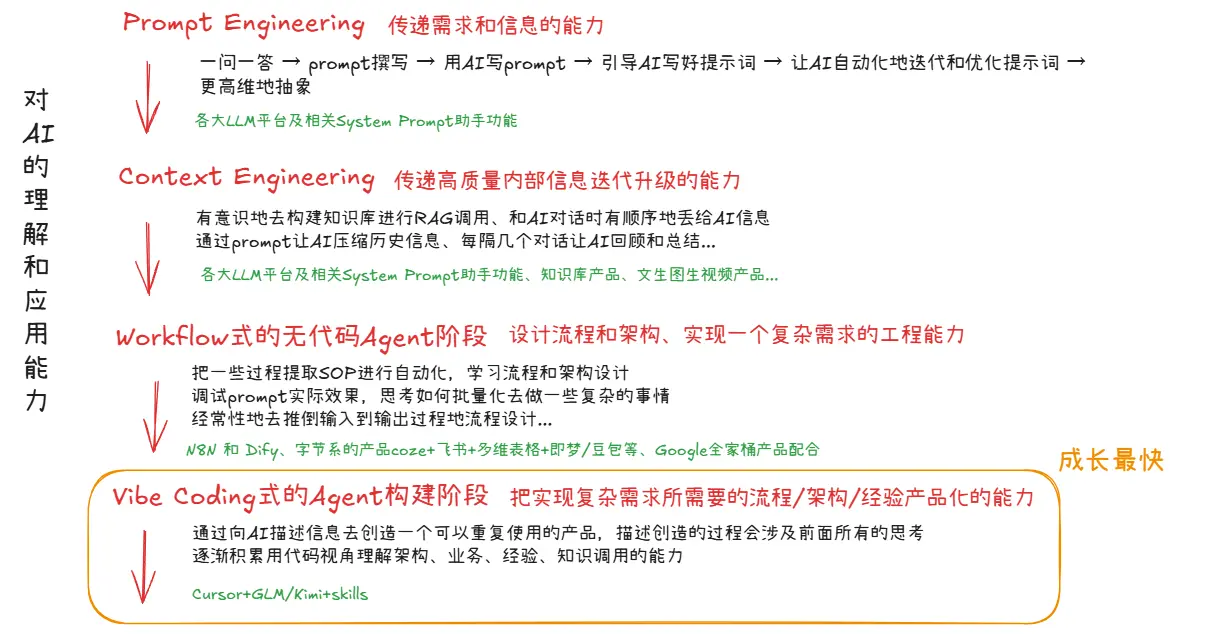
Each new stage arose from the pain points of the previous one. Throughout, my central questions were: can AI do the work in front of me? How? Can it do it at scale? The process also changed and improved my own abilities and understanding of specific marketing work.
Level 1: Prompt Engineering
When I first encountered AI, I approached it as though it were a search engine. I quickly realized that treating it as nothing more than a chat box was a terrible waste. My progression in this stage looked like this:
- From one question and answer to structured descriptions: at first I asked scattered questions and got superficial answers. I began providing longer prompts with background, objectives and constraints, hoping the constraints would produce more dependable results.
- From writing prompts myself to asking AI to write them: I soon felt human-written prompts were often less logically rigorous than AI-written ones. I moved toward a “metaprogramming” approach: describe a rough version of my need and ask AI to generate a structured system prompt.
- From one-way instructions to guided dialogue: AI-generated prompts are not always accurate. I learned to calibrate them with follow-up questions and background, explaining what the final deliverable should look like and who the audience is, so AI can think from my perspective.
- From static templates to a dynamic iteration system: I stopped trying to write a perfect prompt in one go and built an iterative process. For example, I set an instruction such as
/prompt 优化(“optimize prompt”) to have AI revisit the conversation, extract what was left unsaid and improve the prompt on its own.
Main AI products: primarily the chat interfaces and system-prompt features of major Chinese and international LLM platforms.
This stage taught me how to turn vague marketing intuition into standardized requirements a machine can understand.
My current habit has changed completely: first I provide needs, goals and fragments of information and ask AI to generate underlying rules—a system prompt. In practice I keep patching the rules. Once the prompt works well, I save it, and sometimes bring in a third AI perspective to abstract how the logic could transfer elsewhere.
Level 2: Context Engineering
This stage primarily develops the ability to convey high-quality information systematically and improve it through iteration.
Once I wanted more than one-off tasks and hoped AI could become deeply embedded in my business logic, I found that context quality sets the ceiling for an answer. Before, I taught AI how to do one task at a time. Now I deliberately follow its chain of reasoning or construct a logical chain for it, guiding it toward higher-quality output.
- From scattered conversations to a private knowledge base: I began organizing brand research reports, historical marketing cases and competitor analyses. With RAG—retrieval-augmented generation—AI can “open the book” before answering.
- Feeding information in order: instead of dumping everything at once, I learned to provide it in a logical sequence: industry information first, then brand pain points, then competitor tactics, and finally a request for strategy. Along the way, I ask AI to compress prior information or review and summarize every few conversation turns, so information overload in a long conversation does not make it less useful.
Main AI products: alongside major LLM platforms, I began relying heavily on knowledge-base tools such as Dify's Knowledge module and Coze's Multi-Agent mode. Even for text-to-image and video generation, I learned to manage context to maintain a consistent visual style.
This made me realize that a marketer's core competitiveness is no longer just the ability to write a few lines of copy, but the ability to govern the flow of information. Selecting the strongest industry know-how and giving it to AI became a new challenge for me.
Level 3: Workflow-based no-code Agent orchestration
This stage develops the engineering ability to design processes and architectures that handle complex requirements.
When a requirement becomes very complex—such as “automatically break down 1,000 popular Xiaohongshu posts and produce a competitor analysis report”—conversation alone is no longer enough. I began thinking like a programmer: extract a standard marketing SOP and orchestrate it as an automated process.
- From task thinking to process thinking: I learned to design architecture, breaking a large goal into nodes: data collection → post cleaning → content tagging → style extraction → consolidated report.
- Rebuilding and debugging processes: I frequently tore down input/output flows and reconsidered how to handle complex work in batches. I debugged prompts between n8n and Dify, looking for missing logic and places where AI hallucinated more.
- A coordinated toolkit: my arsenal expanded to include ByteDance's Coze, Feishu, Bitable and Jimeng/Doubao, combined with Google APIs. Instead of working as a lone operator, I felt like I was commanding an “AI special-operations team.”
This is an attempt at engineering marketing. The strongest marketers need more than taste and insight; they also need to break subjective experience into rational processes machines can execute.
Level 4: Vibe Coding-based Agent development
This stage develops the ability to turn a vague feeling and a complex architecture into a product.
I consider it the stage where I have grown fastest. Rather than fixating on how to write the underlying code, I describe my intent—my vibe—and business logic to AI to create a reusable product. It is a leap from user to creator.
- Define a product in natural language: the act of describing it draws on all three earlier stages. By explaining the vision and logic, I can ask tools such as Cursor or Kimi to help build a complete marketing tool quickly.
- Reconstruct the underlying system from a code perspective: where I once saw business in terms of “how to sell,” I am gradually acquiring a code perspective: instinctively understanding logical relationships in the architecture and considering how APIs or packaged Skills can turn marketing experience and knowledge access into products.
- Toward the ultimate freedom of not having to work a job: as I package my marketing thinking into independently running Agents, I find myself building a knowledge system capable of evolving. The products I create are not merely tools; they are digital extensions of myself.
At this stage, vibe is the soul. If your understanding of marketing is deep enough and your idea of the product form is precise enough, you can leave the remaining implementation to AI and your own sense of direction.