A One-Person Company in the AI Era: Building a ‘Super-Intelligent Tricycle’ with AI
Translated from the original Chinese article.
A bigger question
A few days ago I shared how I built a content team in an AI IDE in 20 minutes. Afterwards, a bigger question occurred to me:
If AI can make a content team, can it make other teams? If it can make other teams, can it make a company? If it can make a company, can it make a brand or personal IP? And would a company, brand or IP that I create in deep collaboration with AI be, in some sense, AI Native?
Those questions kept me excited all afternoon.
From a strategy house to a tricycle
I started talking with AI, drawing on my understanding of AI Native, work, companies, brands, IP, commercial products and my existing file structure. I asked it to organize and diagram the ideas, observed its answers, revised them based on my understanding, and asked it to continue.
I spent an afternoon on it without getting to the answer, then continued the next morning. Suddenly, it clicked.
My old thinking trap
I used to think linearly, or in a tree: choose several lines, then break each down further. For example, first do my job well, then expand into a side business, then build a personal company, then develop a brand and IP.
At its core, this is the “strategy house” mindset of a traditional organization: find one pillar, then add another, building a company like a house centered on people. To do it, you lay foundations and make many plans or infrastructure investments for a future that may never need them.
Heavy and slow.
After discussing and analyzing it with AI, I felt the one-person company of the AI era should leave that traditional big-company mindset behind and become more agile and convenient.
In plain language: start with a rough understanding of your strengths, direction and where you ultimately want to go. Then set out with AI, exploring and building whatever tools help you get there along the way.
The super-intelligent tricycle
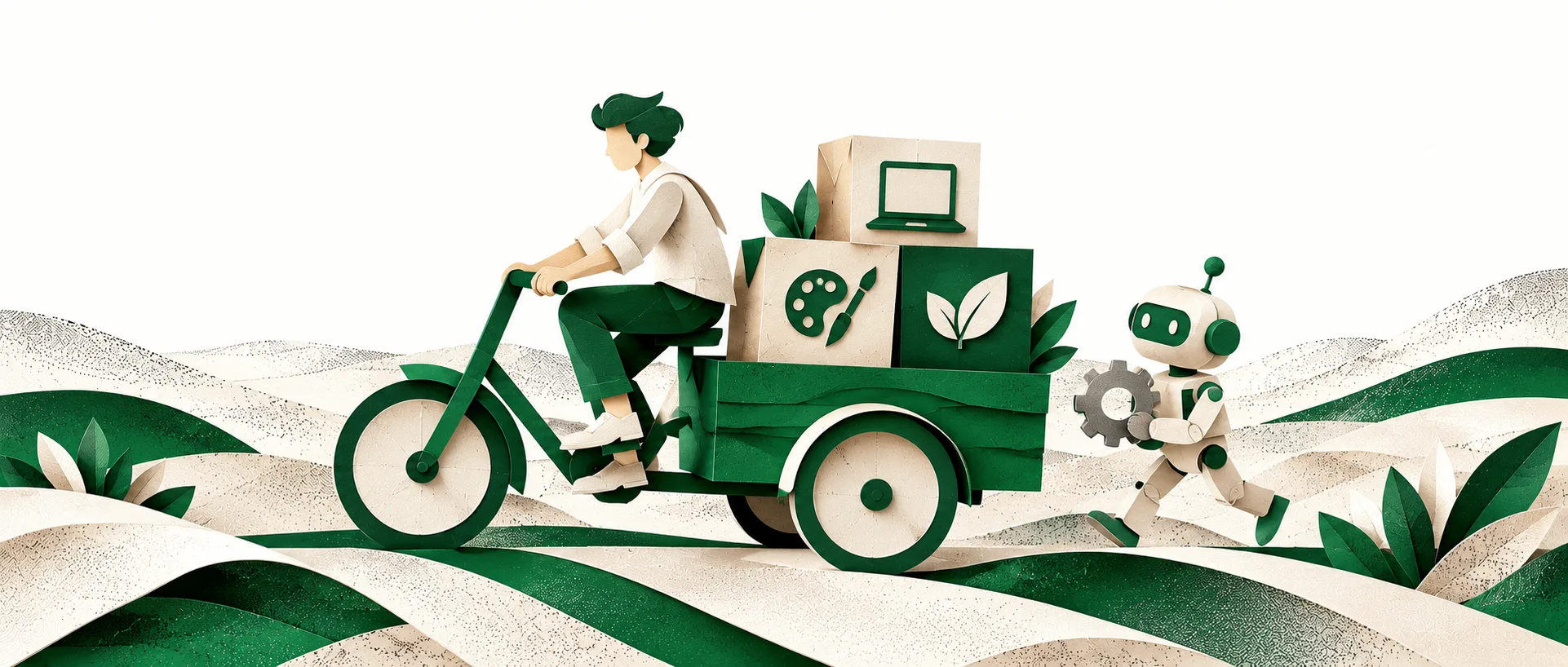
Using myself as an example, if I build a one-person company, I am currently using the products and platforms of large companies to build a “super-intelligent tricycle” with AI.
Its defining features are:
- I am the driver: I define direction and goals.
- AI is the engineer: it understands my needs and creates a “vehicle” that can see the flow of information and data across the whole system in real time.
- The body: assembled from ready-made AI product modules supplied by large companies.
The tricycle has three wheels:
Work
This is the company's current core business. As the person responsible for that business, I sell my time for compensation.
Work gives me practical experience on the front line. It keeps me in real business situations, facing real customer and workplace problems.
Personal IP: “Alchemist Zhou Lengqing”
This is my content account. It addresses why people might favor my future brand. It can also accumulate prospective customers, audience assets and ideas for commercial products.
I intend to keep Building in Public: recording and sharing my thinking and growth throughout the process, and helping others interested in one-person companies.
Brand: SimpleMkt
This is an important base for future commercial development. Drawing on what I learn from the other two wheels, I will build standardized and bespoke products to sell. It addresses what value I can offer the world and whether that value can help others become more fully themselves.
In marketing, my central hope is to return to marketing's essential value rather than meaningless piles of labor, content distribution and ugly advertisements repeated in a loop. With AI's help, I hope marketing can become simpler and purer.
The energy chain: how the flywheel turns
The wheels can be detached, replaced or changed. Running together, they form the forward flywheel of my future one-person company. Because the vehicle is built with AI, AI knows its construction in detail, and an invisible energy chain connects the wheels:
- My work provides grounded, practical material for my personal account. It can suggest commercial products for the brand and provide things to share, helping me reach people on the other side of the screen and receive more feedback.
- That feedback can become new content, experience I use when serving other brands at work, and more consumer-side insight for my own brand.
For example:
I encounter a marketing problem at work → solve it with AI and distill something shareable → record it as content for my personal IP → audience feedback reveals new needs → when enough needs appear, I can identify unmet needs I am able to address → turn the solution into a product and deliver it through the brand → feedback helps me serve customers better again…
That is how the flywheel turns.
Why share this?
It is an experiment
AI-native companies and brands will surely emerge. I want to treat this as a personal challenge and experiment to see whether I can build one.
Authenticity matters more
The supply of content and products will grow explosively in the AI era. Human-centered personal IP and brand assets will become even more important.
When faced with a mass of content of similar quality, I believe people will prefer work that feels real and made by a living person.
Sincerity is the winning move
Most importantly, I think a key issue in the AI era is transmitting information and data without loss.
The more you build in public, the easier it will be for AI to recognize you, your brand and your products.
Everyone will have an AI assistant of their own, and I believe it will prefer to recommend brands and products with more real information and data.
For AI, sincerity is the winning move.
An invitation to explore together
If you are also wondering:
- Can one person own a company?
- Can one person run both personal IP and a brand?
- Can one person build a vehicle of their own with AI?
Follow along and explore with me.
Finally
This “super-intelligent tricycle” is still being assembled. The wheels may not be round enough, the body may wobble, and the energy chain may need tuning.
But the important thing is that I have already set out.
And I am not driving alone. Beside me is an engineer available 24 hours a day, who can see how every part runs and help me improve the vehicle's performance in real time.
It reminds me of a saying: the future is already here; it is just unevenly distributed.
Perhaps the one-person company of the AI era is for those willing to set out early.
What about you? Are you ready to build your tricycle?
Discussion: If you built your own “super-intelligent tricycle,” what would your three wheels be? Share your thoughts in the comments.
Date: February 11, 2026
WeChat public account: Alchemist Zhou Lengqing