In the AI Era, You Need a Personal Website
Translated from the original Chinese article. Some illustrations are from the original and may contain Chinese text.
Lately I have been using AI to improve my personal website, at simplemkt.cc.
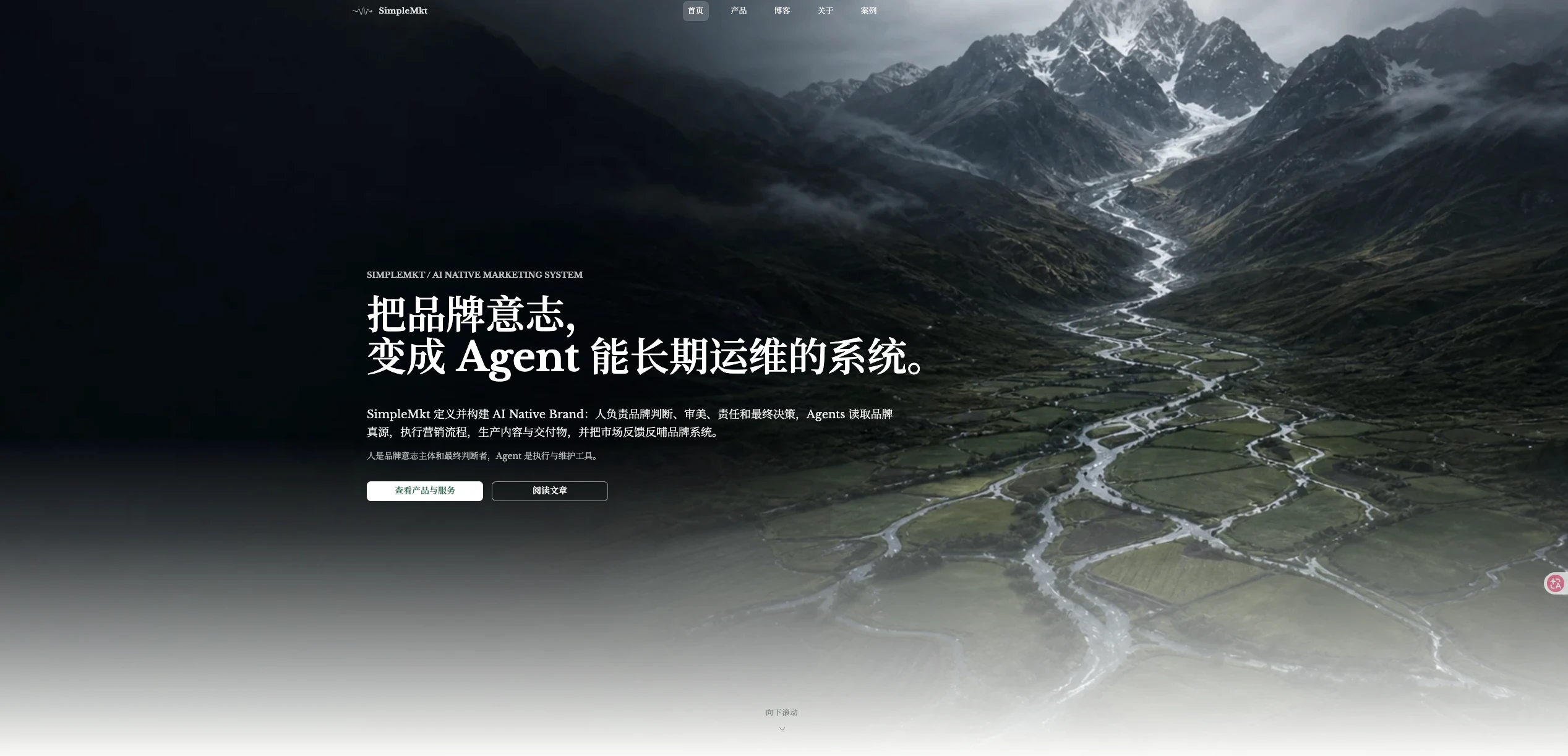
At first I just wanted a page that looked good. As I worked, I realized I had built a home base for my brand, one that could continue to hold my articles, cases and personal experience.
My conviction is growing stronger: in the AI era, everyone should start building a personal website of their own. It need not be particularly complex, and you need not know how to code. But it should be a place you define, that your Agent can maintain and grow over time.
A personal website is a home base for a personal brand
My first approach was straightforward. When I saw a website I liked, I asked AI to analyze its page structure, type, colors and interactions, make an initial demo, and then kept adding content and refining it. If something looked wrong, I sent AI a screenshot and asked for changes.
It was rough, but effective. A personal website is an excellent practical exercise for a beginner learning AI: say something, AI changes some code, refresh the browser, and the result appears immediately.
The site is no longer just a demo. It has a brand homepage, products, a blog, cases and a personal introduction:
- I built the product page in the last couple of days. It includes a commercial service I am developing: a full-stack offering that takes people from learning AI Agents from zero to building a personal business system, combining paid knowledge, community, hands-on consulting and tools. I am also about to start a co-creation project for 5–10 clients, ideally five. I want to find five small-business owners with established businesses who don't know how to integrate AI. I would participate deeply, help turn their business into an AI-native working system and teach them how to do it step by step. After the complete service, I expect them to understand AI and Agents better than most people and even many AI bloggers on the market. Interested readers can see the product introduction on my site—the address is in the comments—or message me. I will also make a separate piece about it.
- Returning to the website: I first built the blog, cases and personal introduction, then made a homepage that automatically aggregates recent articles and selected cases.
- The blog keeps my thinking on AI, Agents, brands, marketing and data analysis over time.
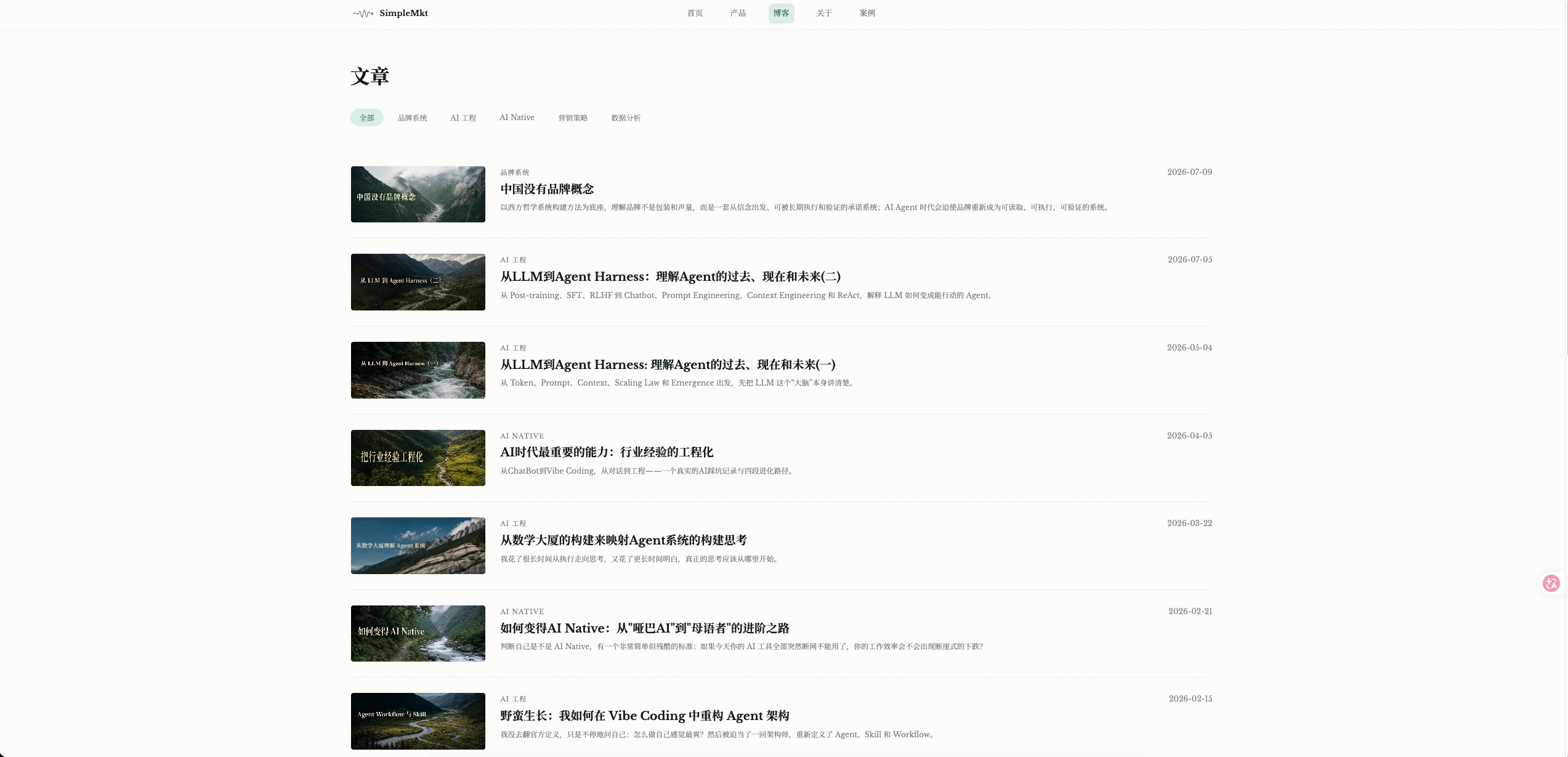
- The cases page preserves real projects and PDF material from my past work.

- The about page explains my experience, where my methods came from and why I started SimpleMkt.
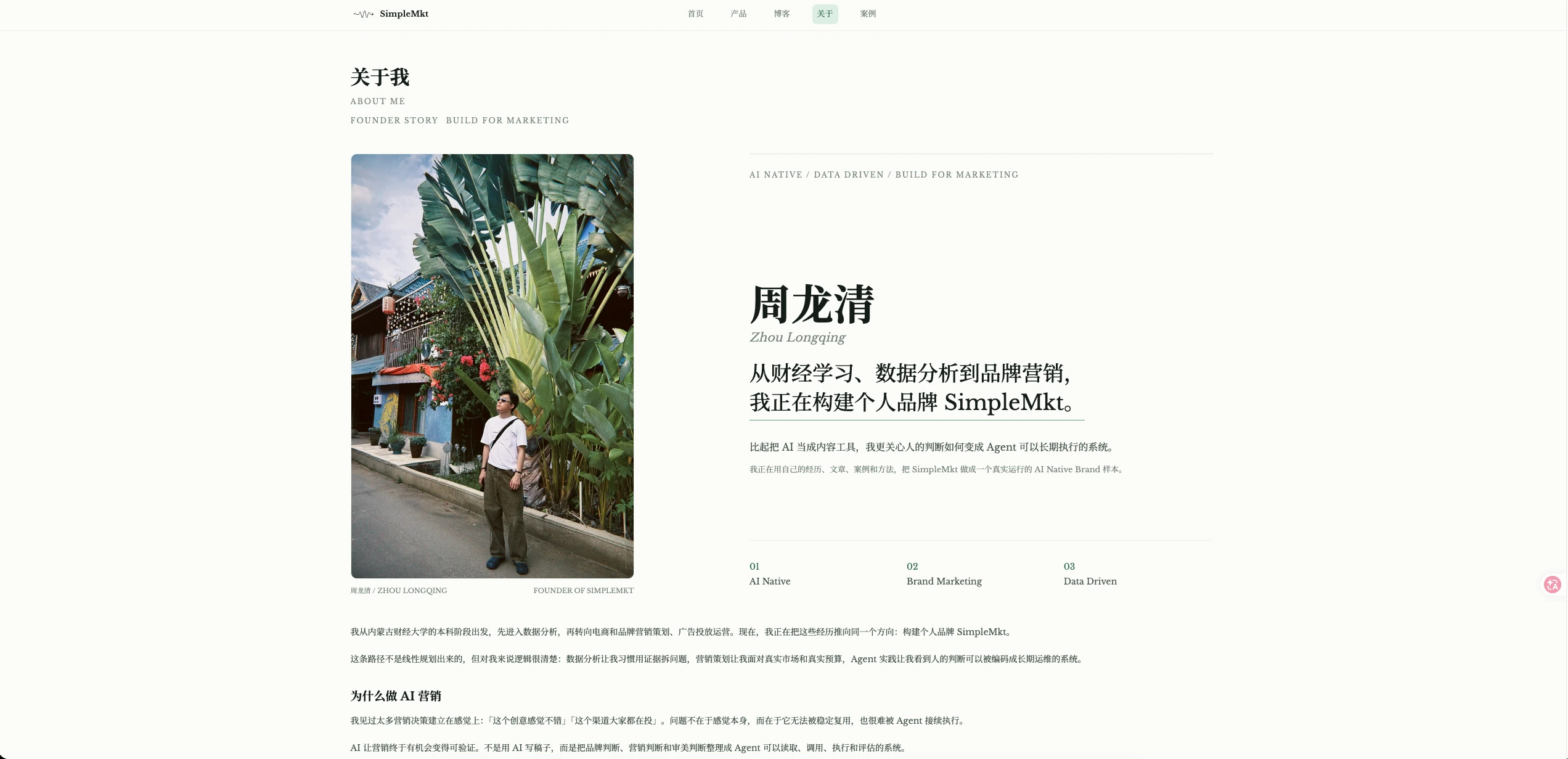
Together, these pages form a relatively complete home base for my personal brand.
I don't want visitors to see only “Hello, this is who I am.” I want them to follow my articles, cases and products and gradually understand how my judgments formed, what I have done, what I am doing now and where I want to go.
I believe that in the AI era, one of the best ways to build trust is to build yourself as a brand.
A personal brand is not a manufactured persona. It is a system that organizes real experience, real judgment and real work so people and Agents can verify them over time. A personal website is useful infrastructure for that.

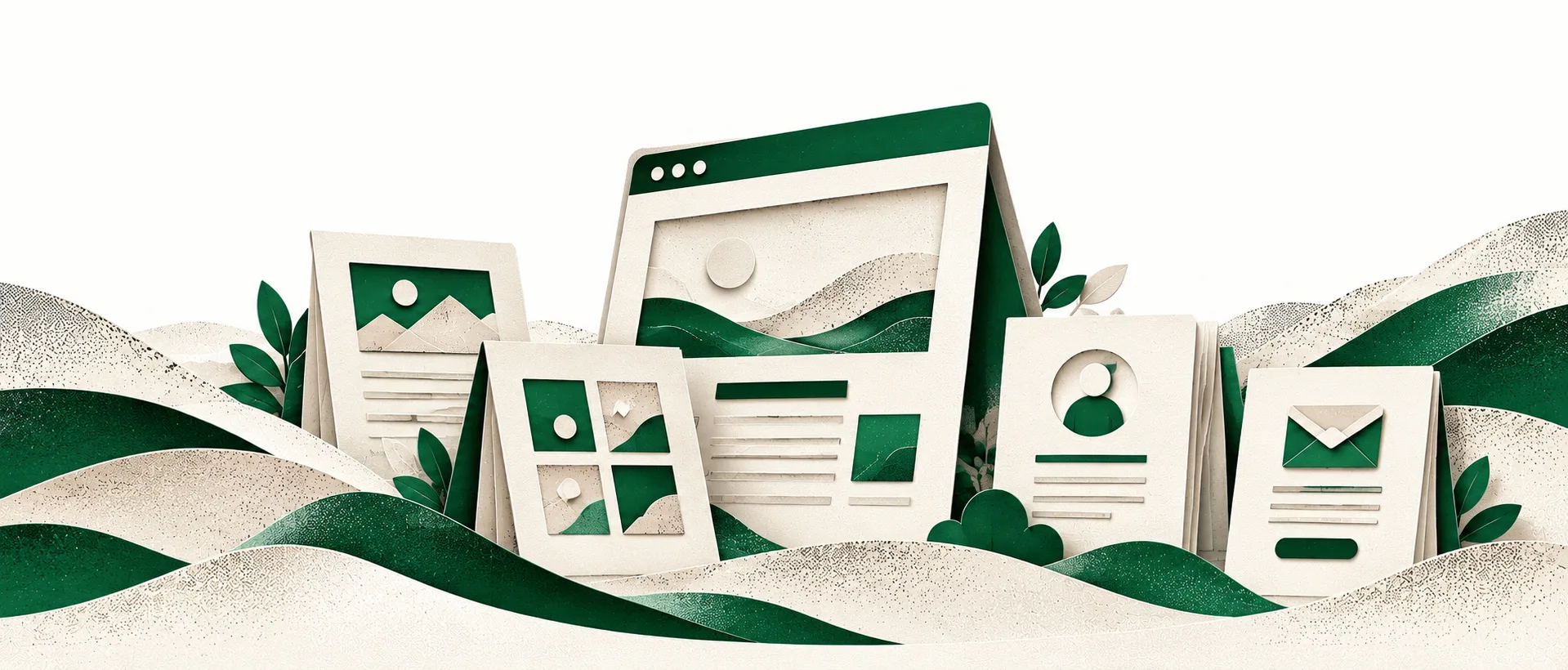
Illustration: a personal website is more than an isolated biography; it brings content, products, cases and experience together.
From asking AI to imitate, to building my own design system
How did I make the current site? If you ask AI to build a website without doing anything else, the result may have an obvious “AI look.”
And if you keep following bloggers, collecting different reference sites and asking AI to imitate each one, it brings back new colors, typefaces and card styles. Each page may look fine alone, but together they become a mess.
I gradually realized the issue was not whether AI could generate a page, but whether I had supplied stable, foundational judgments:
- What typeface feels like me?
- Which colors should recur?
- Should pages feel lively or restrained?
- How large should headings be?
- What text width is comfortable to read?
- What can change, and what should not be decided from scratch each time?
- And so on.
To answer them, I used AI to learn about UI and technology stacks. Then I fixed the preferences I had held over time and packaged them as a personal design Skill.
The site's Chinese and English, primary green, blue action color, off-white background, and basic heading, body and component rules no longer depend on a temporary prompt in a particular conversation. They are written into design configuration as visual constraints the site can repeatedly read.
I can use this Skill over time to add pages or change styles: AI first reads the established rules and generates within those constraints. Instead of repeatedly asking AI to “make me a webpage,” I am building a website system AI can maintain over the long term.
AI generates and executes; I remain responsible for taste, judgment and final choices.
That is what AI Native means to me: not handing human intention to AI, but encoding it into configuration AI can read and execute.
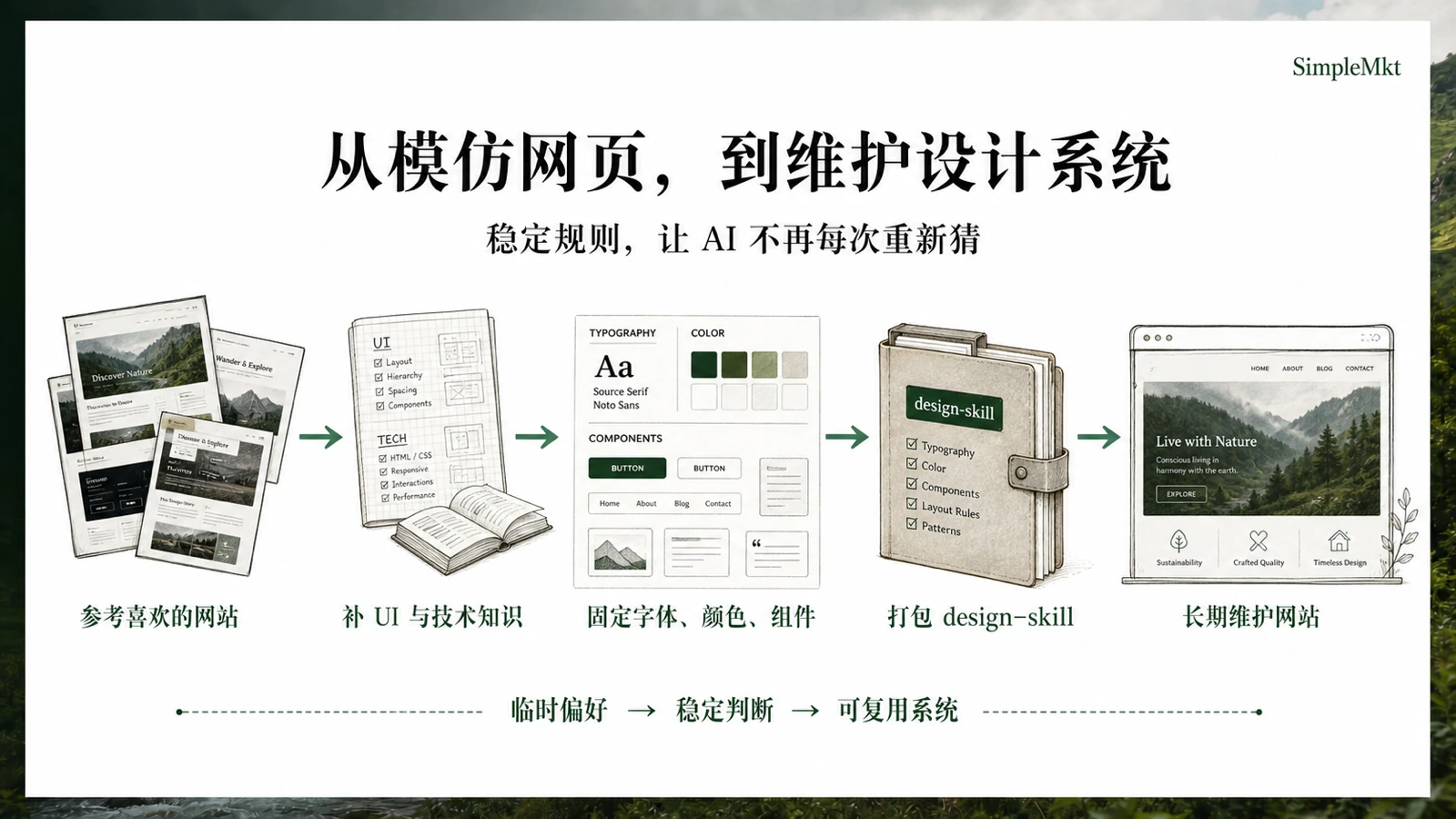
Illustration: sustainable AI-assisted web building turns temporary preferences into stable rules instead of repeatedly copying new pages.
The hard part is not making a website, but continuing to put things in it
A beautiful homepage is not especially hard. The real question is whether it contains new material three months later. If a personal website is not maintained and updated after a year, it loses much of its purpose. Operating it is a long-term undertaking.
How can we make that easier? Turn recurring maintenance actions into dedicated Skills or workflows.
For uploading articles, I packaged checks for title, summary, date, tags and image paths into a Skill. After writing an article I can ask, in the website folder, “upload article X.” It puts the complete article in the agreed location and ensures the displayed format follows my rules.
I also have older work cases stored as PDFs. I turned reading the PDF, translating it into Markdown and uploading it under an agreed background–strategy–process–results framework into an automated process. Original files are converted to WebP images the website can read easily and stored in the appropriate local location.
Reusable Skills can make website maintenance easier and turn the site into a growing home for knowledge assets.
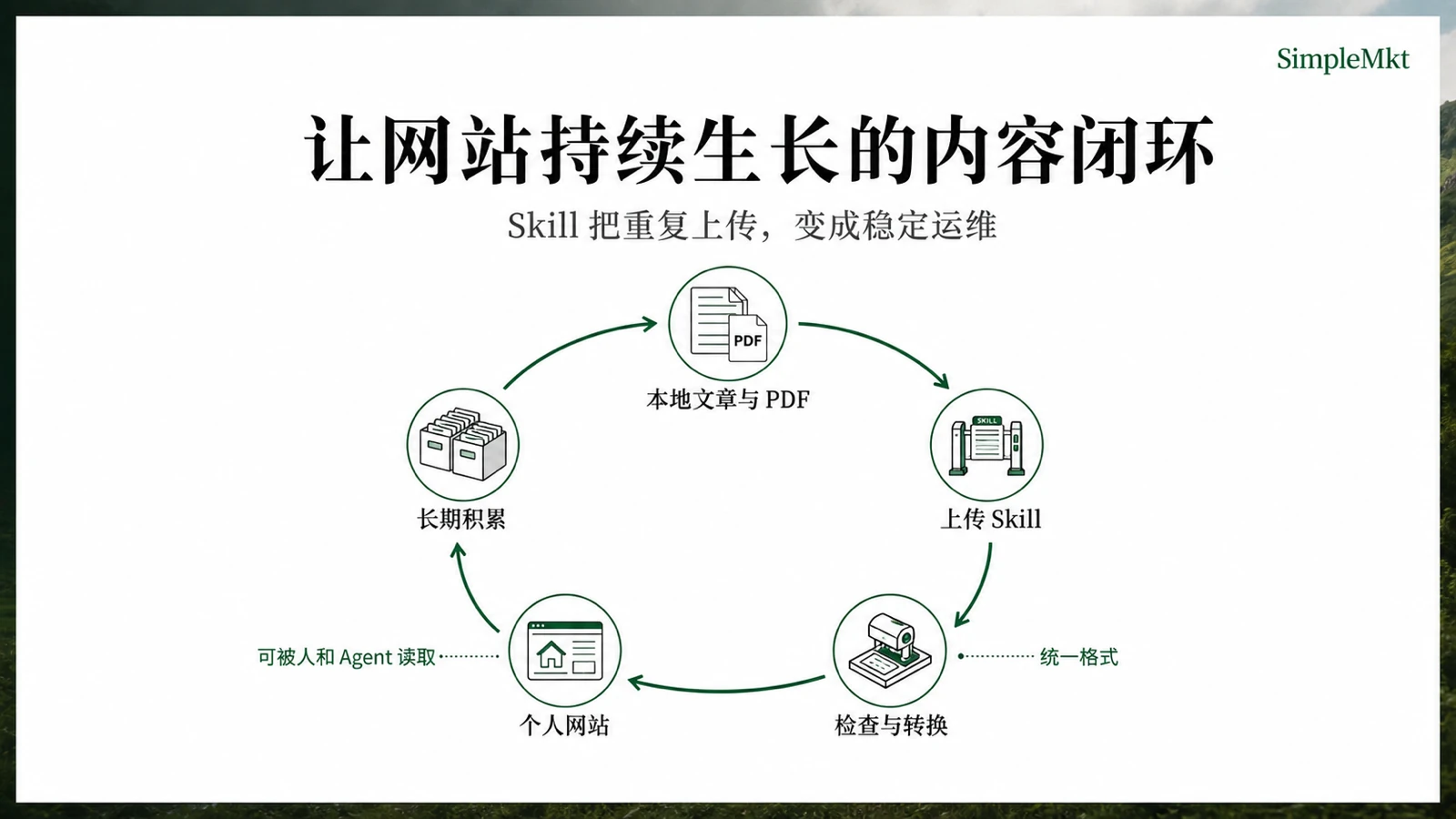
Illustration: turning repetitive article and PDF uploads into Skills makes maintenance a steady loop rather than ad hoc labor.
Why have a personal website in the AI era?
1. It is an excellent practice ground for learning AI
Many people learn AI by saving prompts, watching tool reviews and consuming others' AI content while feeling FOMO. But listening and collecting do not mean you can use it.
Building a site lets you practice the whole process of making a vague idea clear: what you want to make, whom it is for, what content comes first and what counts as complete. After AI produces a result, you must judge, revise and test until it actually works.
It is a complete AI-native workflow:
Intent → description → generation → feedback → revision → judgment → launch.
You do not need to become a programmer. Even a small demo with an about page, work, articles and contact information can show that AI is not just a smarter search box, but a new way of producing.
2. It is a base for data assets and a long-term home for a personal brand
There is nothing wrong with publishing on WeChat, Xiaohongshu, Douyin or Zhihu. I do not think a personal site should replace those platforms. But platforms are more like a public square or shopping mall; a website is closer to your own home.
This is a practical form of digital sovereignty: it helps prevent any one platform from locking you in forever.
3. It lets experience compound instead of being swept away by feeds
Platform content aims to enter the next feed. A personal website aims to become context for the next creation.
An article can connect to a case; a case can demonstrate a capability; a capability can grow into a product.
Someone who discovers you on a platform may see only the person in today's feed. If they become interested and visit your website, they can follow links back years and see how your judgments changed and methods formed.
The difference grows over time. Instead of scattered posts, you accumulate your own knowledge network, reusable as context.
4. It lets both people and AI understand your personal brand
In the past, personal sites were mainly for people. Now there is another reader to consider: the AI Agent.
When your positioning, articles, cases, products and contact information are scattered across closed platforms, AI struggles to find a stable, complete version you have confirmed. It can only guess from fragments.
Organize that material on a clear website, supported by a sitemap, structured content and an index for language models, and the site can become an entry point to your public context.
In the future someone might give your site directly to an Agent and ask: “What has this person done? What do they believe? Are they suitable to work with? Are they trustworthy?” rather than first searching your name and browsing page by page.
I increasingly see the personal website as both a human homepage and an effective interface through which Agents can get to know you.
5. It helps build direct relationships independent of traffic allocation
In “1,000 True Fans”, Kevin Kelly emphasizes that one condition for a sustainable creative career is a direct relationship with people who truly support your work.

A personal website will not automatically bring a thousand loyal readers. But it offers a place that does not have to start again with a platform's algorithm each time. People can bookmark your domain, subscribe to updates, see complete work and find your products and contact details directly.
Social platforms distribute; the website receives and retains the relationship in depth. Content starts from your own system; platforms carry it to more people; lasting relationships can return to your brand home.
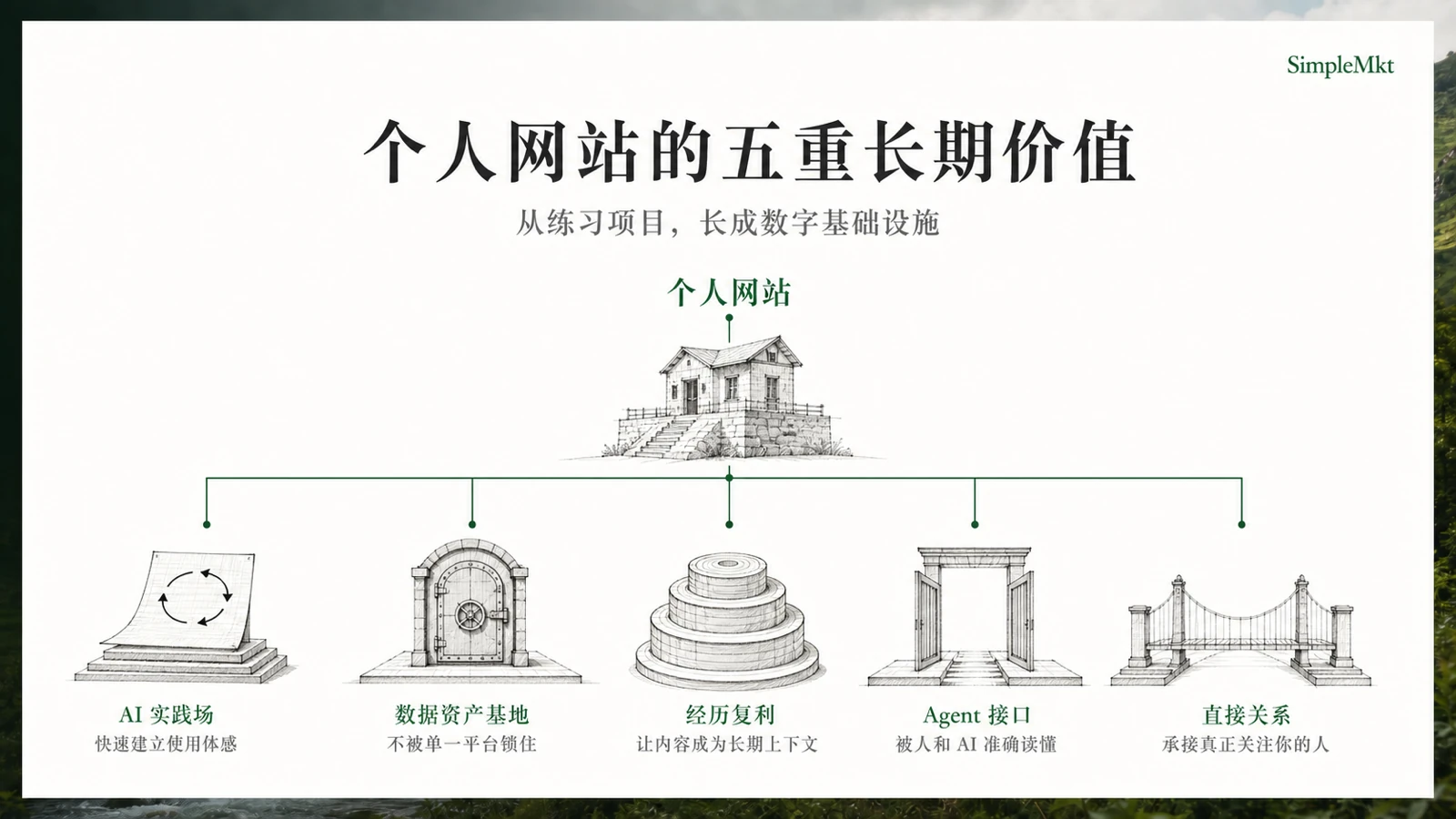
Illustration: a site can start as AI practice and grow into infrastructure for data, knowledge, brand and relationships.
You don't need to be ready before starting
Many people ask whether it is too early to make a personal site when they have no product, little work and no design skills. I think that is precisely why they should begin.
A website is not a display cabinet for after you have succeeded. It is a project that can help you gradually understand who you are.
Start simply:
- A domain of your own.
- An honest introduction.
- Three things you have worked on seriously.
- A few articles you have written.
- A way for people to contact you.
Then use AI to help make it.
In maintaining it, you learn how to express yourself, organize material, judge design and turn repeated actions into processes. Gradually you are building more than webpages: you are building your own digital infrastructure.
Finally
The biggest change AI brings is not merely faster content production. When generative capacity becomes abundant, the scarce things return to people: experience, judgment, taste, responsibility and what you are willing to sustain over time.
If these things exist only in platform feeds, they can be fragmented, averaged out and difficult for future AI to understand accurately.
A personal website offers a chance to put human intention back at the source, then let AI help organize, execute, communicate and maintain it over time.
If you do not have one, consider it as your next AI project. You don't need a ten-year plan first. Start with a smaller question:
If there could be only one place on the internet that represented you fully and honestly, what would you put there today?